The work of the community

Just as we’ve considered the physical layout and characteristics of Pottstown on some maps and on the ground, we can also take a bird’s eye view of how all the different players in the community take on the “work of the community” and how they relate to one another. There are the elected and appointed officials, individually and as members of a public body; non-profit housing, arts, health & wellness, library, shade tree and preservation groups; churches; civic groups like Scouts, fraternal organizations, PTAs; citizen activists; municipal employees; and the private sector that keeps the economic engine running and, in many cases, financially supports the work of the non-profit, civic and religious groups.

If you were hovering above all these groups in Pottstown, who would you see repeatedly crashing into one another? Or who is being deliberately cut out of the game? On the flip side, who sets screens for other players to help them fulfill their role better? Who quietly shows up day after day, year after year, getting their work done?

I am in no way saying that every group and every person in Pottstown must figure out how to work in perfect harmony. Every community needs its watchdogs, especially when there are obvious, serious problems that need to be addressed.

WHAT PROGRESS LOOKS LIKE
It’s not news that many people are frustrated with the status quo. For the past 9-12 months, there has been a growing impatience and vocal expression of frustration in the blogosphere, in the online comments at The Mercury and in person at public meetings. Citizens have formed groups to respond to specific issues. What’s apparently pretty remarkable is that Council, the Borough Manager and the School Board are listening and have begun taking action on some long-standing problems. They are also setting up processes for information-gathering, deliberation and consensus-building. This is what progress looks like.

These will take time, and not every statement or public comment is going to come out perfectly, whether it’s from someone on the inside or the outside of the process. People might not say what they mean in quite the right way. Maybe they have to back-track or re-phrase. If certain lines of communication haven’t ever been used, or not used very often, elected and appointed officials, citizens and bloggers, too, are not going to come out with perfectly-formed thoughts and ideas right off the bat. We’re just human and need to remind ourselves to cut each other some slack – all for the sake of getting the work done.

BACK TO THE WORK
Individuals feel like they’re making a meaningful contribution to the work of a community when they have a defined role – when they are recognized and asked to participate in meaningful tasks with a clear purpose. In Pottstown there’s a lot to be done. Anyone who wants to be part of positive change should be given a chance to do their thing. New people need to be pulled in. The court is big here and there’s no five-player limit.

Right about now you might be thinking: “Yeah, yeah. That all sounds just so nice. Now who’s going to FIX things?” Recently – I can’t find it now – someone posted a comment on one of the local blogs to the effect that the town has been down this road before. They hire someone who’s expected to do miracles, it doesn’t happen, they leave and the town loses again. They may have predicted that would happen with the new director of PAID/The Pottstown Partnership… and where does that stand now, anyway?

NO MIRACLES HERE
First, every public entity would do itself a huge favor by figuring out how to more frequently update the public on its activities. We live in a wired world; the expectation is that information should be available, if not immediately, then within a few minutes! Every entity, although not the Partnership yet, has its own website and should be keeping the public informed, even in an informal way. I understand that minutes from meetings are not official until they’ve been approved. But especially in a time of transition – Pottstown seems to be transitioning to a new era of responsiveness & action – when frustration and skepticism still run high, regular, simple updates would go a long way toward gaining citizen confidence.

Second, there is no miracle worker on the horizon for PAID or for Pottstown. You don’t even want to think like that. It’s a set-up for failure, for that individual and for the community. At this point, I’d like to go back to a link in my previous article. It was Wikipedia’s definition of Comprehensive Planning, which showed this step-by-step process:

• Identifying issues
• Stating goals
• Collecting data
• Preparing the plan
• Creating implementation plans
• Evaluating alternatives
• Adopting a plan
• Implementing and monitoring the plan

Whoever heads up the Pottstown Partnership is going to have to do all these things in an open and transparent way that brings out the best in those who are already in the community. Let’s face it, Pottstown can be – to quote Rodney Dangerfield – “a rough crowd.” And I say that with all the affection and pride in the world! 🙂 Whoever comes in would do well to create an economic development plan of action WITH the stakeholders as well as FOR the stakeholders.

Third, you can’t just order up a whole new team! The individuals and groups that already exist in town are certainly capable of listening, learning, gathering information, assessing, making decisions, implementing and monitoring them. They may have fallen short in the past, to varying degrees, but evidence is mounting that they are moving on now, trying to do better and succeeding. These are not miracles. These are people following the outlines of a thoughtful, planning process and getting a job done together.

Next up: Forces and resources outside the Borough’s borders

How one planner thinks

After months of getting pulled in closer, learning a lot, and meeting and talking with a lot of people, I’d like to now write more specifically about the planning, land development and community development challenges facing Pottstown. I’ll be writing with several different, intertwined perspectives in mind. The urban planning part of my brain is influenced by my point guard/leader/coaching brain, and it’s all (still) informed by the experiences of living in Pottstown, going up and down its streets in cars, on a bike, running or walking on my own two feet, during my formative years. I’ll try to show my thinking on the page, and in the process I hope to re-frame the way the community thinks about its challenges and what it wants to be, so that it’s better positioned to get there. If something doesn’t quite make sense or I’ve got a basic assumption all wrong, I apologize in advance. Let me know so I can re-assess things based on reality.

As to the title of this blog post… I’m going to lean heavily on a sports analogy here at the beginning. I see a connection between being a point guard in high school and college and then finding myself in the planning profession. A key concept & goal of the profession is to be comprehensive in outlook. And being a point guard means “seeing” and keeping track of everything that’s happening on the court.

Example: On a fast break, a point guard might not even know exactly who she’s passing to. She just sees the color of her teammates’ jerseys spread out in front of her. She sees opposing jerseys. She sees an open space that a teammate might move into, to get closer to the basket, and she tosses the ball to that space, believing her teammate will move to it, get the ball and score. You don’t want to make or encourage moves that have people crashing into one another. Teammates need to keep good spacing, but they do need to come together, say, when one sets a screen for another. They move closer together, then they move apart. It’s about seeing space and color and individuals working in concert. (Just re-read that… could almost describe a land use map too.) Ideally, it’s one big orchestrated dance that has spontaneity, too, based on trust and instinct.

On several different levels, I think about community development and comprehensive planning, at its best, as a series of orchestrated movements, where different people and groups are playing their roles to the best of their ability. The goals are reasonably attainable, based on the skills that everyone brings to the game. In hoops, you don’t want a schedule where you’re always losing and stuck in an unhealthy frame of mind. In community or economic development, you don’t want to set goals you can’t reach.

So let’s think of a really, really large court; let’s think of several bird’s eye views of Pottstown. A zoning map, historic district map, and homeowners’ initiative map all give a different view. Different uses, zones and priorities have been assigned to different spaces for specific reasons. Yes, these can be modified over time for many reasons. But no land use recommendations or decision should be made without regard to surrounding properties and the uses/priorities assigned to adjacent zones. Sounds simple, but in reality, it’s easy to get carried away from such a basic consideration.

I started writing what you’ve just read, after getting – ah, irked – at a July 31st Mercury article about an “energy plant” that comes with a landfill, proposed for the former Stanley G. Flagg site. The Mercury followed up with a glowing opinion piece on August 1st. But just because something comes in green wrapping paper doesn’t mean it’s good for a particular community.

From a bird’s eye view of Pottstown’s zoning map, I imagine truck after truck delivering municipal solid waste to a flex office zone that has parkland on one side and a narrow gateway zone and neighborhood residential on the other side. Parkland. Green Garbage. Gateway/Neighborhood Residential. This would be an example of incompatible uses crashing up against one another – in short, a badly run play.

I’m generally in favor of green initiatives! But every activity – even a green one – has to be considered in its context, in its specific location. And Pottstown has to start getting serious about how it markets itself. There are other green activities that it can explore and try to bring to town that don’t involve garbage at its western gateway. (We’ll get to these in this series, down the road a bit.)

Okay, so eventually, we need to print out a copy of the maps, come down out of the sky and see what’s exactly on the ground. It’s best to walk around with map in hand and get a sense of the scale of anything that’s already there or in the vicinity. There’s a whole other level of sensory awareness of what makes a “place” work. What do you see, smell and hear in a neighborhood or on a particular site? Does it feel safe?

When friends are looking for a new house in a new community, I advise them to stop in at the municipal building and visit the planning and engineering offices. Ask to see their maps and (here in NJ) the town’s Master Plan. Ask what’s going on. I also advise them to visit their potential new neighborhood at several different times during the day and night. Look for railroad tracks and airports; is there a lot of noise? Truck traffic? Commuter traffic? Bring the kids to the potential house, park the car, get out and walk to the park or school or ice cream shop together to see how it feels. Is it going to work for your family?

We’re all going to have our own opinions and different tolerance levels for all kinds of activities. But a town’s maps, and the ordinances that underlie and support those maps, represent existing public policy. Periodically, you re-evaluate them, you talk it out publicly and you might change them. You make exceptions only for very compelling reasons. To me, though, this is your starting point as a community. Your maps and your ordinances say who you are, how you want to grow, what you want your town to be.

Next up: Who’s doing the “work of the community?”

First Suburbs, Keim Street Bridge & Keystone Blvd. extension

Exactly the kind of issue that would benefit from analysis and advocacy by the First Suburbs coalition is how PennDOT and the Delaware Valley Regional Planning Commission (DVRPC) set transportation funding priorities.

From their website: “The Southeastern Pennsylvania First Suburbs Project is a regional coalition of community leaders from developed suburbs that have joined together to harness their communities’ power by directly engaging citizens to affect policies and practices that will lead to the stabilization and revitalization of their communities.”

They’re holding the Building One Pennsylvania Summit tomorrow, Friday, July 16, 2010, 10:00am – 4:00pm (doors open at 9:00) at Thaddeus Stevens College of Technology, 750 E. King Street, Lancaster, PA.

I know a few Pottstown residents are going and I hope someone is going to officially represent the Borough.

In a recent presentation to Pottstown Borough Council, a representative of the DVRPC described how the funding for the repair/replacement of the historic Keim Street Bridge wouldn’t be available for approximately 6-8 more years, or completed for at least 10 years. See The Mercury’s video here. The issue was also discussed by Jeff Leflar on the Code Blue blog.

In the video, Council President Stephen Toroney notes that, ideally, the bridge would be re-aligned with Keim Street AND Keystone Boulevard would be extended to the Route 422 Stowe interchange, thus allowing Pottstown to be part of the 422 flow rather than cut off from it. Toroney rightly pointed out, “That’s the key to our Bethlehem Steel site. To get some businesses in there.” He asked about the possibility of fast-tracking and a public/private partnership to make those things happen. It wasn’t clear, due to the video editing, whether the DVRPC representative ever responded directly to those questions.

I would not let this go. And I don’t mean that in a confrontational way. I mean that there is a strong regional planning case to be made for addressing this root-cause, which is directly connected to jobs and fiscal stability, through recurring dialogue and a working relationship with these agencies specifically around this issue.

This problem is reminiscent of the ultimate effect on many of our nation’s cities of the Federal Highway Act of 1956, which funded the interstate highway system. Massive roadways and overpasses cut downtowns off from their rivers and diverted people, in their vehicles, away from city centers, opening up the countryside to housing and malls – what we now call “sprawl” – and leading to the disinvestment in urban cores.

On a smaller scale, that is what the current PennDOT/DVRPC transportation funding schedule perpetuates – the continued re-routing of traffic (and consumer dollars) around a town center/small city. This funding schedule, even if unintended, is in effect their public policy. It is a policy that, due to inadequate access for the movement of raw materials and finished goods, actually also hinders private sector economic development dollars from flowing into Pottstown.

For Pottstown’s former industrial sites ever to be re-used to their fullest, the newly formed Pottstown Partnership (which includes the County) will want to hit the ground running in talks with PennDOT and DVRPC to re-consider the current timeline on the Keim Street Bridge and to get the Keystone Boulevard extension on the table. The Partnership will also need to actively engage property owners, determining any clean-up and marketing strategies that will put these sites back in use. They are absolutely essential to Pottstown’s revitalization. None of these efforts toward the Pottstown Industrial Complex should be news. They are part of Goal #1 in the Action Plan of the Pottstown Economic Development Strategic Plan (March 2008).

There may be a history here (of inaction) such that funding agencies might be leery of directing resources where they’re skeptical about their ultimate benefit. Fair enough. That’s where the Borough – on its own and in the context of the Partnership – needs to step up and be pro-active with property owners, pro-active in seeking grants for brownfields redevelopment and putting together a package of other financing incentives, and leading the way in this kind of First Suburbs conversation.

“Tell us what you think about Pottstown.”

That was an online headline at The Mercury this past Friday, June 25. And then it said, “What positive changes need to be made for Pottstown borough to move forward? Tell us in the comments section below.”

Hmmm… I wondered, “Is this a set-up? Is The Mercury deliberately taunting me over here at Positively!Pottstown?”

I’m sorry, dear readers, I couldn’t hold this in any longer! Here’s what I posted over there this afternoon (as Number5).

” Dear Mercury: thanks for asking! I’ve been thinking about doing a series of blog posts about all these interrelated issues, so I guess this is kind of a jumpstart. Sorry for the length – a lot of pent-up thoughts! And my m.o. is to throw a lot out there and see what resonates on the ground – that’s the spirit in which this is offered.

I’m going to stick with the positive spin of the question – suggesting positive changes.

Pottstown, what’s your story? You need a vision and a voice to communicate that vision. It’s got to go deeper & get more specific than the generalities in study after study. For example: former industrial center retains what is good about its small town past AND re-invents itself for the 21st century. It values its river, historic architecture, walkability, neighborhoods, community gardens and businesses that MAKE things. While the industry used to be all about steel, pies, auto parts, etc., now the town makes art, dance, music, recycled-fashion designs, and solar/green technologies. What the heck, maybe it’s home to several organic coffee roasters too. (This is an example!)

What if just about every decision made by town or a local property owner or civic group took that kind of vision into consideration? There are places billing themselves as “sustainable cities.” Maybe Pottstown could be a “sustainable town”? Could something like that provide the framework for guiding revitalization decisions in Pottstown?

Pottstown has never been for the faint-of-heart; hard-working, gutsy immigrants made this community what it was in its heyday. Now is no different. Arts and business entrepreneurs, who have higher risk levels than the average Joe, would totally be in keeping with Pottstown’s immigrant past.

So, where are these risk-takers? You’ve got a bunch of them in the arts and restaurant community in town already. Another commenter has already mentioned them. Any day now, the Pottstown Arts & Cultural Alliance is going to launch a totally cool new website. PACA is on its way to putting a very new face on outsiders’ perceptions of Pottstown. They are adding value to this community by what they do every day and, now, by more effectively communicating what they offer. And they’re just getting started.

The business community and property owners are critical. Bottom line: You gotta fill the spaces on High Street. I’m putting out there right now: If anyone in the business and real estate community wants to put together a clearinghouse website to market their Pottstown properties in an attractive, easy-to-understand format that SELLS, I will gladly help make that happen within, say, 90 days. I’m from out of town and I’ve gone looking for properties as though I were an investor, and it’s not easy to even find out what’s available, let alone where might be some good locations for specific uses like a café or a used bookstore/literary venue or whatever.

Community groups: reduce fragmentation wherever possible. Join forces around a common, positive, pro-active vision. Link to and intersect with the arts, business & educational communities wherever appropriate.

Good government. There’s no way around this. There has to be a “good government” halo around Boro Hall that can be seen from Routes 422 and 100. Anyone stepping into the building has to know they will be treated courteously, fairly and consistently. There’s got to be follow-through. You got an ordinance on the books, you enforce it. If it doesn’t make sense in your new vision of yourself, you set out on a course of careful, PUBLIC consideration, you ENGAGE the affected parties/property owners, and you change it. The arts, business and community groups can go pretty far if they’re all pulling in the same direction, but unless the foundation of government is strong and inspires confidence, yeah, people are going to be hard-pressed to trust their investments here.

Nail down the vision ASAP. Preferably without paying for another study! Communicate the vision, whatever it is, through your ACTIONS. (I’ve got some more specifics to throw out there, but will deal with that on the blog.) Everyone: get your stories straight and tell it that way, over and over again, every time your organization or collective reaches a milestone, large or small. Give the naysayers less and less to talk about, especially on public message boards! ”

” Sorry, meant to sign that post:

Sue Repko
Positively!Pottstown ”

Hoop Dreams, Hoop Memories

Tonight I’ll be at Father Doyne Hall at St. Pius X for one last run up and down the hardwood. While I’m proud of a lot of things accomplished during my Pius years, being part of two Ches-Mont championship teams in 1978 and 1979 ranks right up there, mostly because a lot of people thought we couldn’t do it, but also because I now think of it as a defining period for me, personally and politically, although I would not have described it that way then.

In the course of doing research for a memoir I’m writing about growing up, I’ve spent some time at the microform reader at the Pottstown Public Library, reading old articles from The Mercury. As so often happens, while I was looking for one particular article, I got distracted by another.

Back in those days, a sportswriter by the name of Ken Murray* had a column in The Mercury called “Ken’s Corner.” On June 21, 1974 it was titled, “Is There Room For a New League?” and it was all about St. Pius X looking to get into a new league now that the Suburban Athletic Conference had disbanded. Murray wrote, “What league could the small Catholic school join without stepping in over its head?” He goes on to speculate about a league of smaller schools, perhaps including Pottsgrove, Upper Perk, Methacton and Landsdale Catholic.

I’m pretty sure I read that piece back then, even though I would have been just eleven years old. I was a sports junkie. I followed major league baseball, basketball and football. And that was the year that I – and a handful of other girls – barged our way into Little League baseball in Pottstown. Back then, competition – any competition – felt like a matter of life and death to me. (I’m not always proud of that, but that’s for another time.) As a tomboy, I’d had a chip on my shoulder for as long as I could remember. Anything a boy could do, I wanted to do better. And then sports opportunities for girls were federally mandated through the passage of Title IX in 1972, and I felt personally vindicated.

Another reason I’m pretty sure I was a regular reader of Murray’s column is because I’d met him right around that time. Eight days after the Pius piece, his column featured me, one of my teammates (Caren Holsberger), and our baseball team (M & M Green) in “A Lonely Battle for Sue, Caren.” (That’s the article I was actually looking for.)

In middle school at St. Al’s I dreamed of playing basketball for Pius (the Suburban Catholic League champs in 1974), and it’s not inconceivable that I carried a kind of “I’ll show you, Ken Murray and all you other doubters” attitude around for years until I got the chance. Pius entered the Ches-Mont my junior year. The league had some big schools – Coatesville, Downington, West Chester Henderson, West Chester East, Pottstown. Murray was absolutely right. Pius was a small school. It was the only Catholic school. And we were all white. Racial tensions from the 70s still ran high; I remember police escorting us off the bus at some schools. Playoff games and title games were fraught with emotion and a kind of danger. And we won. Yes, we had some amazing talent (shout-out to my classmate and teammate, Carol Glutz, the school’s all-time leading scorer.) But under Coaches Bernadette and Bill Travers, we also worked our butts off. Every day.

All of this opened my eyes to a larger world: laws got passed in Washington that affected me personally. Gender equity, race relations, and social unrest weren’t far-away concepts that just appeared in headlines. They played themselves out in our own towns and on basketball courts. I think I was also tuned in because I was in the midst of getting a Catholic education, steeped in the values of social justice. While I have not been a practicing Catholic for quite some time, that blood still runs through me. There’s no shaking that, nor do I want to.

So, when I step on the court at Pius tonight and pose for photos with our championship banner with my sister, Michele Dunleavy (varsity girls’ coach at Phoenixville), and my old teammates and friends, all this – and a whole lot more – will be running through my heart and head. And through my veins. St. Pius X will always be more than a building. Its spirit will continue to move through all those who walked its halls and played on its courts and fields – sometimes as though their lives depended on it.

* Could Ken Murray, former sportswriter for The Mercury be the same Ken Murray covering the NFL for The Baltimore Sun? That would be very cool. 🙂

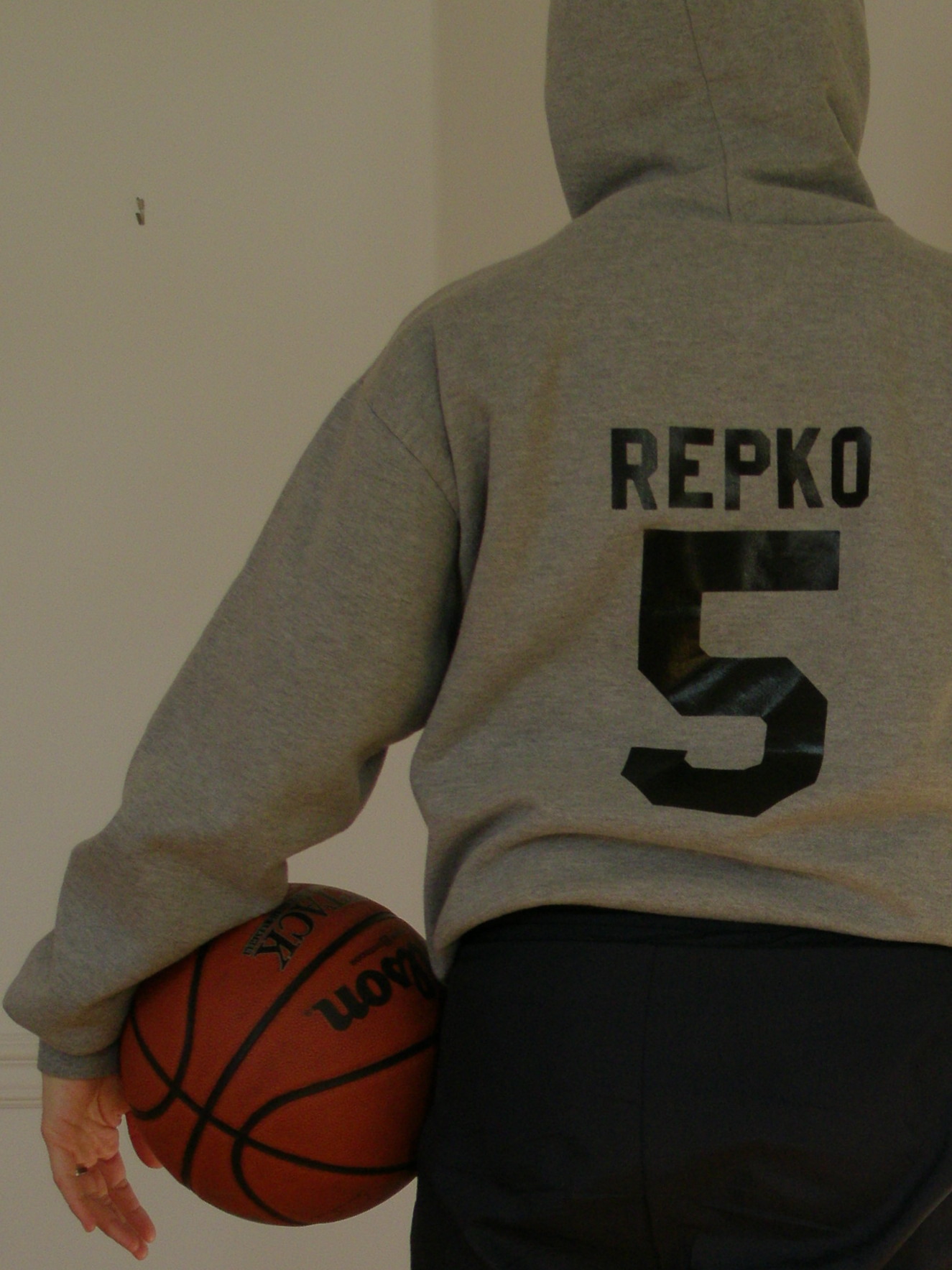
Proudly wearing the #5

Mercury article on founder of Positive Psychology

Given the name and attitude of this very blog, and given I was a psych major in college, I was intrigued to see this article by Dennis J. Wright in today’s Mercury about Martin Seligman, the founder of the relatively new field of positive psychology. Seligman, who teaches and does research at the University of Pennsylvania, spoke at Ursinus on Tuesday.

It seems Seligman used to study “learned helplessness and depression,” fairly common stuff in a field that focuses on what’s wrong with people and how to fix them. His current emphasis on positivity, though, comes at happiness from the other end of the spectrum: find out what your strengths are and put them to work to ward off depression.

In this 2008 profile, Seligman said, “There are three levels to happiness: pleasure, the delight you get from chocolate, fast cars, and sex; engagement, the feeling of “flow” you get when you’re doing something you’re good at; and meaning, the fulfillment you get from being engaged in an effort greater than yourself.”

At Ursinus, Seligman talked about how to apply these principles in education, maintaining that happiness – or how to achieve a fulfilling life – can actually be taught.

Extending this concept to the community-level, I’d put out there that Pottstown itself is in the midst of figuring out what its strengths are, capitalizing on them and starting to feel the “flow.” Look no further than Citizens for Pottstown’s Revitalization and “Hip Places to Be Scene in Pottstown,” the latter of which should be releasing a new video any day now. I guarantee you’ll have no trouble smiling at that 🙂

Welcome from the Town Square!

Hello, Mercury readers and thanks for stopping by! I want to thank The Mercury for setting up the Town Square on their home page and giving me a chance to share all the things – old and new – that I love about Pottstown.

Tapping into my background in urban planning and creative writing, I’ll be blogging about arts, cultural and community events and revitalization… in addition to food, sports, wellness and business, with the occasional trip down memory lane tossed in for good measure. This blog is a new venture, having gone “live” just a few weeks ago, and I hope it’ll be a forum for others to share ideas and notes on cool happenings around town. Please feel free to jump in!

Positively yours,
Sue Repko

Blog at WordPress.com.

Up ↑