Preservation Pottstown’s July 4th Activities

Preservation Pottstown is a non-profit group that undertakes a host of activities to support and celebrate what’s awesome about Pottstown.

One of their premier events is the Patriotic 5K Run, which will take place this year on Saturday, July 3rd. Parking is at The Hill School‘s Center for the Arts at Beech & Sheridan Streets, Pottstown, PA 19464.

Registration begins at 7 a.m. at The Hill School, and the gun goes off at 8 a.m. See the 5K Race page at the July 4th website or download an entry form here. For more information, call 610-970-6607/6608 or 610-970-6618.

Preservation Pottstown is also a sponsor of Bike Pottstown, the free bike program run by Tri-County Bicycles at 256 High Street. They are rallying a contingent of bikers for the July 4th Homecoming Parade. Tri-County Cycles has 3o bikes in their fleet, available to the first 30 riders who show up. Kids and adults are encouraged to bike into town or bring their bikes, if you’re from out of town, and meet up at the bike shop around 9:45. From there, all bikers will go together to High and Keim Streets to wait for their turn to join the parade, which starts at 10:15.

Bikers will get to see everyone in front of them and, then, when they reach the end of the parade route, they will get to see everyone behind them. Bikers will not miss a thing! So, tape a few streamers to your handlebars, put on your red, white & blue and bike over – I will see you there!

July 4th in Pottstown!

Plans & schemes are heating up for fun & games at The Pottstown July 4th Homecoming Celebration, now in its 32nd year !

Positively!Pottstown is teaming up with Code Blue on a 50/50 raffle, where 50% of proceeds goes to the July 4th Committee and 50% will be split between two lucky winners. Tickets are $5 each; or 3 for $12. Code Blue volunteers & lil ‘ol me will be selling tickets on Friday evening and all day Saturday at the main tent (near the sound booth), throughout the park, and along the parade route. We’ll be trying to sell 1,000 tickets. Support Pottstown’s 4th and you could win big!

A huge thanks to Smale’s Printery on Charlotte Street for the good price & quick turnaround!

Tomorrow: Preservation Pottstown’s 5K Race and calling all bike riders for the parade!

and
POSITIVELY!POTTSTOWN
50/50 RAFFLE TO SUPPORT

50% split by 2 lucky winners

50% for Pottstown July 4th Committee

Drawing held before the fireworks.

$5/ticket ● $12/3 tickets

“Tell us what you think about Pottstown.”

That was an online headline at The Mercury this past Friday, June 25. And then it said, “What positive changes need to be made for Pottstown borough to move forward? Tell us in the comments section below.”

Hmmm… I wondered, “Is this a set-up? Is The Mercury deliberately taunting me over here at Positively!Pottstown?”

I’m sorry, dear readers, I couldn’t hold this in any longer! Here’s what I posted over there this afternoon (as Number5).

” Dear Mercury: thanks for asking! I’ve been thinking about doing a series of blog posts about all these interrelated issues, so I guess this is kind of a jumpstart. Sorry for the length – a lot of pent-up thoughts! And my m.o. is to throw a lot out there and see what resonates on the ground – that’s the spirit in which this is offered.

I’m going to stick with the positive spin of the question – suggesting positive changes.

Pottstown, what’s your story? You need a vision and a voice to communicate that vision. It’s got to go deeper & get more specific than the generalities in study after study. For example: former industrial center retains what is good about its small town past AND re-invents itself for the 21st century. It values its river, historic architecture, walkability, neighborhoods, community gardens and businesses that MAKE things. While the industry used to be all about steel, pies, auto parts, etc., now the town makes art, dance, music, recycled-fashion designs, and solar/green technologies. What the heck, maybe it’s home to several organic coffee roasters too. (This is an example!)

What if just about every decision made by town or a local property owner or civic group took that kind of vision into consideration? There are places billing themselves as “sustainable cities.” Maybe Pottstown could be a “sustainable town”? Could something like that provide the framework for guiding revitalization decisions in Pottstown?

Pottstown has never been for the faint-of-heart; hard-working, gutsy immigrants made this community what it was in its heyday. Now is no different. Arts and business entrepreneurs, who have higher risk levels than the average Joe, would totally be in keeping with Pottstown’s immigrant past.

So, where are these risk-takers? You’ve got a bunch of them in the arts and restaurant community in town already. Another commenter has already mentioned them. Any day now, the Pottstown Arts & Cultural Alliance is going to launch a totally cool new website. PACA is on its way to putting a very new face on outsiders’ perceptions of Pottstown. They are adding value to this community by what they do every day and, now, by more effectively communicating what they offer. And they’re just getting started.

The business community and property owners are critical. Bottom line: You gotta fill the spaces on High Street. I’m putting out there right now: If anyone in the business and real estate community wants to put together a clearinghouse website to market their Pottstown properties in an attractive, easy-to-understand format that SELLS, I will gladly help make that happen within, say, 90 days. I’m from out of town and I’ve gone looking for properties as though I were an investor, and it’s not easy to even find out what’s available, let alone where might be some good locations for specific uses like a café or a used bookstore/literary venue or whatever.

Community groups: reduce fragmentation wherever possible. Join forces around a common, positive, pro-active vision. Link to and intersect with the arts, business & educational communities wherever appropriate.

Good government. There’s no way around this. There has to be a “good government” halo around Boro Hall that can be seen from Routes 422 and 100. Anyone stepping into the building has to know they will be treated courteously, fairly and consistently. There’s got to be follow-through. You got an ordinance on the books, you enforce it. If it doesn’t make sense in your new vision of yourself, you set out on a course of careful, PUBLIC consideration, you ENGAGE the affected parties/property owners, and you change it. The arts, business and community groups can go pretty far if they’re all pulling in the same direction, but unless the foundation of government is strong and inspires confidence, yeah, people are going to be hard-pressed to trust their investments here.

Nail down the vision ASAP. Preferably without paying for another study! Communicate the vision, whatever it is, through your ACTIONS. (I’ve got some more specifics to throw out there, but will deal with that on the blog.) Everyone: get your stories straight and tell it that way, over and over again, every time your organization or collective reaches a milestone, large or small. Give the naysayers less and less to talk about, especially on public message boards! ”

” Sorry, meant to sign that post:

Sue Repko
Positively!Pottstown ”

Summer Performing Arts Camp at Tri-PAC

By now many readers of this blog have experienced – I hope! – at least one performance at the Tri-County Performing Arts Center at 245 E. High Street in downtown Pottstown. If not, don’t worry – they just keep comin’. Having just put on a widely-acclaimed production of Ragtime, The Musical, they recently announced their Summer Concert Series, which will feature the Jen Chapin Trio on July 16, the Travis Wetzel Trio on July 30 and Maggie and Mark Moliterno and Friends on August 20.

Also on tap is Tri-PAC’s 7th annual Performing Arts Summer Camp for children. There are 3 sessions to choose from, beginning on July 5th, July 18th and August 2nd. Each session lasts two weeks. There are some spaces still available, so email or call today! (Contact rebecca@villageproductions.org or call 610.970.1199)

The summer camp offers students entering grades 1-12 a chance to explore drama, voice and dance with professional instructors. A new format for middle and high school students allows beginners and more experienced performers to try out one of these areas of concentration or advance their skills, whatever suits their interests or needs.

Students in grades 1-4 will take part in an interdisciplinary curriculum, giving them broad exposure to improvisation, theater movement, vocal expression, writing/drawing and making instruments. They can attend for half- or full-day with short breaks in the morning and afternoon, along with lunch (which is “bring your own.”)

For students in grades 5-12, it’s a full-day program from 9am-4pm. This year Tri-PAC has added concentrations in acting, voice, and dance, so that these older kids can work intensively in one of these areas. A student can still be a beginner and sign up for one of the concentrations and really immerse themselves in it. Half the day is spent in their area of concentration and the other half is spent working to put together an ensemble performance, which will be presented on the last day of each two-week session.

For students in 11th and 12th grades (and recent high school graduates) there is also a Counselor-In-Training program.

Tri-PAC’s summer camp options continue to evolve to encourage participation in the performing arts by newcomers and experienced students alike. If you’ve got a budding performer in your family, check it out! There is a Student Referral Incentive program and need-based financial aid available. Full information and registration forms are available at http://www.tripac.org.

RAGTIME – A musical for our time

Where is the America we were supposed to get? Was it a silhouette?”
In the musical RAGTIME, Tateh, an Eastern European Jewish immmigrant sings these words as he despairs over the health of his young daughter, whom he has brought to this country to make a better life in the early years of the 20th century. But he may also be singing for today’s immigrants and even the native-born, who are struggling to make ends meet, to hold onto a job, and to provide health care and safe and decent housing for their families.
RAGTIME, based on the novel by E.L. Doctorow, is an interwoven tale of the haves vs. the have-nots, corporations vs. workers/unions, black vs. white, newcomers vs. the gatekeepers, and tradition vs. women’s rights, all during a time of great change in our nation.

Village Productions is putting on RAGTIME now at the Tri-County Performing Arts Center in downtown Pottstown. The current production engages audiences on several levels – emotionally, musically, spiritually and intellectually. I attended last Sunday’s matinee with my mom and aunt, and as the story and music unfolded before me, I had the growing sense that this was becoming one of the most powerful theater experiences I’d ever had. The fact that this was happening on High Street, in my hometown, which itself is facing some of the same struggles that these characters face – that made it all the more poignant.

The wealth of talent in this company is mind-boggling. The voices are incredible and fill the theater with sorrow and joy. I had a lump in my throat throughout, and a couple scenes in particular still inhabit my psyche nearly a week later.

In one, the character of Mother, brilliantly played by Julie Eurillo, gives us a distinct moment – a pause – when she must decide whether she will accept responsibility for another woman and child in need. It struck me then how we are constantly faced with moral choices. To what extent am I my brother’s or sister’s keeper? What should I do?

Another indelible scene is when the character Coalhouse Walker, Jr. holds his son for the first time. He has been an absent father until that point, but he didn’t even know he had a child. Played by Gary Giles, Coalhouse hums a series of slow, almost primal, notes of recognition and love that come from way deep within. For me, Gary Giles will always be Coalhouse.

The production and staging are inventive. Two video screens keep the audience oriented geographically as the scenes shift from various locations in New York City, New Rochelle, NY, Massachusetts, and Atlantic City. Somehow there’s a 14-piece orchestra above the set, and the costumes are astonishing.

RAGTIME runs this weekend and next. Last weekend was the theater’s biggest opening yet, and the word is out about this remarkable show, so don’t wait. Shows take place Thursday, Friday and Saturday evenings and a Sunday matinee, until June 20. Ticket info. can be found at Tri-PAC’s website.

First Suburbs – Challenges of Rental Housing

As property values diminish and services are cut, First Suburbs usually begin to see a decline in rates of homeownership, creating a steady pool of vacant and less expensive properties for investors. In any discussion of the challenges that some rental markets may pose, though, it’s important to distinguish between tenants and buildings.

Depending on the slant of landlord-tenant law in a particular state, and the extent to which tenants in a community are aware of their rights, they may not have a strong voice to advocate for themselves and the condition of their buildings. In any public discussion about housing policy, all parties would be well-served to be careful not to lump all tenants into any broad category. Certainly, public policy itself should never seek to exclude based on negative stereotypes or broad assertions.

Tenants are people. I’m not trying to be a wise guy. This sometimes gets lost as frustrations mount, buildings deteriorate and discussions get heated. But tenants do become the neighbors, classmates, friends and employees in a community; they become citizens of the community. I’m not sure if such a program exists anywhere for tenants, but if community organizing is picking up speed – I’m thinking of Pottstown here – maybe there’s a way to incorporate a kind of Welcome Wagon program into the efforts. The best way to get new residents to understand and come to value community norms might be as simple as knocking on a new tenant’s door, saying “hello,” offering a folder with information, including their rights, and, yes, maybe a homemade pie. (I am talking about Pottstown, after all )

Although I have a lot of faith in the power of pie, of course it’s not going to solve a fiscal crisis. In no way do I mean to minimize the fiscal effect of increasing numbers of lower-income and special needs students straining a school district and the taxpayers. But the blanket blaming of tenants is not the answer. There are larger issues that have to be dealt with to turn a town toward greater homeownership, increased business investment and a stable tax base, so that the school district has a greater capacity to provide needed services. Enforcing the existing laws on the books would make a huge impact, not only on the day-to-day experience for current residents, but the perception of outsiders, funding sources and new businesses, about how well the town itself functions.

My first full-time job out of college was with the Section 8 program in Trenton. I did inspections all over the city, followed up on repairs, negotiated with landlords and re-certified tenant income. Several days each week were spent in the field, doing scheduled inspections. Other days were spent in the office, meeting with clients and keeping the paperwork moving. A quick look at Pottstown’s website shows that all the pieces are in place to carry out a rental registration and inspection program.

There’s the zoning ordinance, the required form for the initial registration of a property, the schedule of residential rental registration fees, the checklist for the inspection of residential rental units, and the inspection application with a change in occupancy. I am not sure why I have read/heard that the program is “voluntary.” The ordinance states that owners or rental agents “are required” to submit registrations and update any changes in occupancy.

In a recent post, a local blog – The Pulse! by a citizens’ action group, Code Blue – reported that a request for a list of all the Borough’s rental properties could not be accommodated because no such list exists.

Whether that was done in error or not, an excellent starting point for a rental registration list would be a list of the non-owner-occupied properties from the Montgomery County Board of Assessment Appeals. The entire property file, with all the data collected for assessment purposes, is available online. This wonderful tool allows anyone to search, for example, by Land Use Code and find out that Pottstown has 352 duplexes, 94 triplexes, 52 quadplexes and 43 conversions to 5 or more apartments.

It is not possible to use their advanced search function online to find out all the properties where “property owner address” does not equal “property address.” But the county will send the entire file, or just that search/sort, for $53 to anyone who requests it through the open public records process, as I recently did.

All of this is to say that there is a pretty good, existing list of non-owner-occupied units based on County data. So, what are the obstacles to running a rental registration and inspection program? Do fees need to be set to cover the cost of administration? Is current staff trained and ready to go? Administrative systems would have to be put in place to handle the incoming data and to assist in the monitoring and follow-up. Funds would have to be budgeted initially to notify ALL property owners by mail, website, newspapers and blogs that the ordinances are now going to be enforced as of a certain date, maybe 60 days out. And that fines will be levied for non-compliance. And that the police will be tracking the properties where they are called out three or more times for disturbances, which has its own consequences.

Enforcing these provisions is no different from enforcing tax collections. In fact, this kind of enforcement is possibly more critical to sending the message that a town is on top of its game, which is really the first step toward attracting new residents and economic activity.

First Suburbs: Affordable Housing Notes from NJ

Affordable housing policy is near the top of any First Suburbs agenda and rightly so. In towns that are experiencing the economic disinvestment described earlier – the loss of industry and large and small businesses – the value of the housing stock becomes more critical to the property tax base. And because education is by far the most expensive part of public services, a strong housing market is essential. Yet, the housing markets in First Suburbs suffer the same kind of disinvestment. How can the cycle be broken? Of course, that’s the multi-billion dollar question. And, of course, there’s no way I can answer it. All I can offer here is a resource for your further investigation of the regional and statewide inclusionary zoning system that has evolved over the past 35 years in New Jersey. I hope that these notes and links can inform the conversation and spark some ideas that help SEPA’s First Suburbs as they advocate for more equitable housing policies in their own region.

The New Jersey Fair Housing Act was passed in 1985 to try to even out social, economic and educational disparities between cities and suburbs. The Legislature passed it in response to a couple of New Jersey Supreme Court rulings, Mt. Laurel I (1975) and Mt. Laurel II (1983). The first decision basically found that large-lot zoning laws didn’t allow for a variety of housing types at varied price levels, which excluded people of color and of lower incomes. The second decision created the foundation for a system for determining a “regional housing need,” the “fair share obligation” of individual municipalities in that region, and the “builder’s remedy,” described below.

The Fair Housing Act created a Council on Affordable Housing and a vast body of regulations and calculations to assign a “fair share” number of low- and moderate-income units to each town based on a variety of factors. The program was voluntary. Towns could submit Housing Plans, get them certified through a lengthy process, and then be monitored for compliance. The “carrot” part of this approach was that if towns did this, they couldn’t be sued by builders or housing advocates over their zoning. But if they didn’t participate in the system, they could be subject to “the builder’s remedy” whereby a builder/developer could sue the town to increase the zoning density so that he could provide affordable units in a new development – usually 20%, which would remain affordable (price-restricted) for 30 years. Special housing courts with judges and court masters – urban planners who specialized in affordable housing – would hear these cases and make decisions, essentially taking zoning control away from the non-participating towns. That was the “stick.”

When the Legislature stepped up to pass the Fair Housing Act (and stop the Supreme Court from interfering with local zoning), it created a mechanism – Regional Contribution Agreements (RCAs) – to water down the court’s influence by allowing towns to buy their way out of up to 50% of their affordable housing obligation. “Sending” towns could pass bond ordinances and send the money – based on an agreed-upon per unit fee – to a designated “receiver” city in their region. In this way, some towns reduced the number of affordable units built within their borders, but they also provided urban areas with much-needed rehabilitation and new construction funding at a time when the federal government was cutting these programs. Still, it was clearly a way around the original intent of the court decisions.

More than 25 years later, in July 2008, the NJ Legislature and Gov. Jon Corzine abolished the RCA provision and also created a non-residential development fee of 2.5 percent to be charged on non-residential construction or improvements to raise revenue for the construction and rehabilitation of affordable and workforce housing in the state.

New Jersey’s system grew out of strong, grassroots advocacy for lower income people in the state’s cities, who knew that inner-city residents were being systemically kept out of better public schools, and safe and clean environments due to exclusionary housing laws. Builders were also pushing against these laws for their own gain during a period of generally remarkable economic growth in a state with ever-diminishing developable land.

We are in a very different economic and political environment now. One of Gov. Chris Christie’s first moves was to order a 90-day moratorium on most of the activities of the Council on Affordable Housing. The NJ courts once again stepped in and issued a stay on a portion of the order, while it is on appeal. The Governor is now reviewing the results of a Task Force on the matter. Even though many suburban towns truly voluntarily participated in this system, changed their zoning, and opened up their communities and schools to low- and moderate-income residents who might not otherwise have been able to live there, the complexity and the burdens of this system are legendary here. It has certainly produced affordable housing (see numbers here) and some degree of economic and educational opportunity for thousands. But there are still very real differences separating our cities and more affluent suburbs, namely, blatant racial segregation. Still, I think those Supreme Court justices back in the ‘70s and ‘80s were on the right track, recognizing that ordinances and public policy can have discriminatory effects and staying on the alert to try to counteract any systemic inequities.

New Jersey’s property tax/school funding system is broken – to say nothing of “home-rule,” our 566 municipalities and 605 school districts! The current widespread fiscal crisis only puts that in high relief. Finding political, social and economic solutions, that are also pragmatic, remains our challenge – and probably will be for some time to come. Taking New Jersey’s experience into consideration, though, may help SEPA’s First Suburbs get a better feel for how some housing policies might play out at the intersection of the private and public sectors in their own hometowns.

Note: The original post said that Gov. Christie’s recent order was repealed; a stay was issued on a portion of the order while it is under appeal.

Sue Repko is a writer, licensed urban planner in New Jersey and a member of the American Institute of Certified Planners. She grew up in Pottstown and blogs at Positively!Pottstown.


Community Gardens & First Suburbs – the start of a (long) conversation

This is the first in a series about First Suburbs of Southeastern PA.

This past Saturday a community gardening project took place at a corner park in the heart of Pottstown’s historically African-American neighborhood. The Washington Street corridor has faced its share of challenges over the years – challenges that many would characterize simply as “urban.” But by all accounts the gardening project was a huge success, bringing together a diverse array of children and adults, members of the broader community, and the energy of two organizations – Citizens for Pottstown’s Revitalization and Preservation Pottstown.

At The Mercury, this was news, before and after the event. Two local blogs, Code Blue and Save Pottstown!, promoted it ahead of time. And I certainly was thrilled to blog about it after the fact, thanks to the quick emailing of photos and updates from those in attendance.

To me, the fact that there was such a buzz is interesting in and of itself. What did this activity spark in individuals and the community? Can we try to define it, and in the process, become conscious of it, and try to do it again? There are all kinds of metaphors that spring forth from the gardening/growing process that are apt here. But I also think the actual process of growing food and flowers is good and vital… and not for just one neighborhood. Rather, it’s something for all of Pottstown and the school district to consider as a powerful tool for revitalization, which brings me to the First Suburbs Project.

According to their website, “The Southeastern Pennsylvania (SEPA) First Suburbs Project is a coalition of community organizations and institutions focused on solving common challenges facing the older, developed suburbs of Bucks, Chester, Delaware, and Montgomery Counties. These communities share conditions of diminishing economic investment, declining infrastructure, struggling school districts, and social services lagging behind the needs of their residents.” Older suburbs and towns, like Pottstown, now find themselves face-to-face with a host of public challenges that were once thought to be the province of larger cities.

These conditions are the result of a self-fulfilling syndrome that works something like this:

Over a long period of time, disinvestment occurs due to range of causes, usually a combination of public policy and “free market” forces. Businesses and homeowners with rising incomes leave for literally greener pastures, creating sprawl. The people and businesses that remain must pay more in taxes to maintain the infrastructure, level of municipal services and school system. But these tax increases are too much for some more people and businesses; they leave. Over time, in an attempt to rein in taxes, services are cut. Property values do not go up under these circumstances, making properties concentrated in these areas attractive to investors, and decreasing the percentage of homeowners in a community. This downward spiral picks up momentum, and the chances for an economic recovery diminish even further

The (SEPA) First Suburbs Project advocates “state policy changes and regional solutions” as the best way to tackle these common challenges.

There will be a regional public meeting of the First Suburbs Project this Thursday, June 10 from 7-8:30 pm at South Hall on the Western Campus of Montgomery County Community College in Pottstown. SEPA First Suburbs coalition members want to hear the concerns, ideas, and questions of area residents, organizations, businesses and government officials about their very real experiences in the kind of environment described above.

I’m a firm believer in the potential for regional planning and public policy to mitigate these problems, and I encourage everyone to get to this meeting, speak out, listen and learn more about the possibilities for changing some of the inequities in public policy at the regional, state and even federal levels.

That’s on the one hand.

On the other hand, Pottstown cannot afford to wait for larger, slow-moving, governmental/political behemoths to change their own deeply-entrenched fiscal and social policies. Pottstown must continue to try to define a new course for itself ASAP… while simultaneously pursuing broader changes with other communities that find themselves in the same boat.

And this is where I come back to community gardens.

Below is my quick list of what might have made that such a great experience for those who were involved, and why it brings a smile and hope to someone reading about it. Readers should feel free to add to the list.

What’s Great about Gardening

    – Getting hands dirty; being a kid (again)
    – Adding beauty to surroundings
    – Transformation before your very eyes
    – Having responsibility to care for something that’s your own
    – Being given the chance to nurture
    – Anticipating wholesome food
    – Being around cheerful adults
    – Being pro-active; feeling of taking control, being in charge
    – Sharing snacks/food with other human beings after a job well done
    – Feeling that you are part of a caring community, not alone

    As I’ve blogged before: Community gardens are growing in popularity, especially in places where wholesome foods, such as fresh fruits and vegetables, are not available or are too expensive. Basically, an available lot is divided up among interested residents and/or groups/clubs. Someone who knows something about gardening coordinates and teaches, so that participants end up with a steady flow of food and flowers. Of course, donations of tools, plants, seeds, soil are sought to make it all happen. Community gardens get people outside, get neighbors working together, provide better food at a lower price, raise awareness about nutrition and food production, and put an empty or nuisance lot to good use.

    During World Wars I and II, Victory Gardens in private yards and public parks were considered one’s patriotic duty to ease pressure on the food supply.

    So, what does this have to do with Pottstown’s revitalization on a larger scale?

    Private gardens were very much a part of my growing up. Just about everyone grew tomatoes. Picking apples and making applesauce were, and still are, an early fall tradition for my mom. These were traditions enjoyed by many immigrant, hard-working families that came to Pottstown to work, raise a family and improve their standard of living. Small-scale gardening is part of Pottstown’s past, and in these fiscally-challenging times, it makes a whole lot of economic sense to think about how to bring it back… but with a modern take.

    What if Pottstown became known as a place with a strong private and community gardening movement in its neighborhoods and the schools?

    As a non-resident, I don’t know the extent to which any of the items on the brainstorming list below are possible or already in the works. My inclination is to always just put ideas out there to see if any of them resonate on the ground, where people live.

    Ideas for Extending the Washington/Chestnut Park Project

– Identify a few Borough- or District-owned lots throughout town that might be suitable
– Factor garden space into the District’s land/building planning process, right up there with other energy-saving/sustainability measures
– Seek out several individuals with expertise and enthusiasm to guide smaller, working groups & organizations around town and in the schools.
– Get Bud Heller, Director of Food Services for the School District, on the case. Heller is a tireless advocate who has testified before Congress on behalf of the Fresh Food Produce Association and the School Nutrition Organization.
– Incorporate student-grown produce into menus?
– Is the healthy food program at Edgewood still going strong? Expand to other schools?
– Incorporate organic, small-scale food-growing concepts into science curricula
– Highlight the natural world in fiction, poetry and non-fiction in the English curricula
– Have science & English classes periodically come together for joint projects
– Is there a sustainability club in the high school?
– Have there been quantifiable efforts to reduce waste – in the cafeteria, paper, lights in classrooms, etc.– that engage the kids? See The Green Cup Challenge, which the Hill School has participated in. Tap The Hill, Montgomery County Community College and the Pottstown Garden Club for advice. So many people and resources right in Pottstown!
– Gardening does not have to be expensive; built-in labor pool in schools. Knowledgeable and generous landscapers and suppliers are out there, such as Eric Schmidt of Colonial Gardens, who provided materials for Pottstown’s gardening project.
– The Pottstown Health & Wellness Foundation’s grant program and Mission Good Nutrition videos are additional, key local resources.

The community gardening concept could be a way for Pottstown – and other First Suburbs – to take a past practice that was sensible and sustainable and re-claim it in a way that will appeal to anyone who wants to live in an engaged, progressive-minded community today. The power of people working together on an activity so basic to human survival should not be underestimated. Last weekend’s project at Washington & Chestnut Streets has given a glimpse of the positive, communal energy in Pottstown that is looking for a meaningful outlet. In a time when so much in the world seems out of our control, gardening can put some kind of power back into the hands of the people.

Note: The Pottstown Health & Wellness Foundation’s grant program and Mission Good Nutrition videos are additional, key local resources, which were inadvertently omitted from the original post.

Sue Repko is a writer, licensed urban planner in New Jersey and a member of the American Institute of Certified Planners. She grew up in Pottstown and blogs at Positively!Pottstown.
First Saturday Festivities!

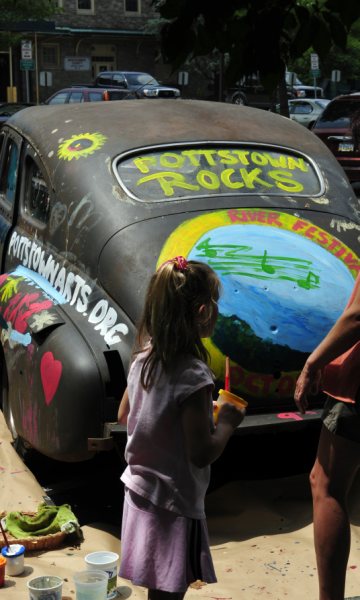
Car Art
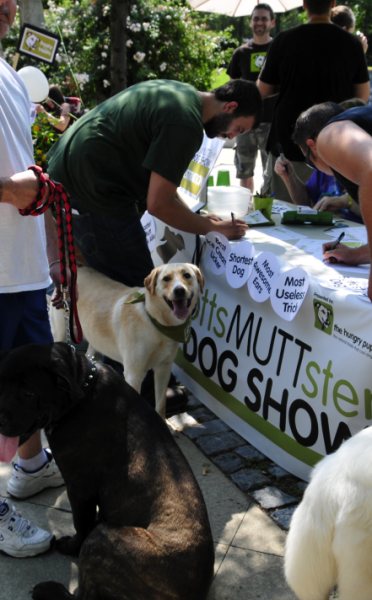
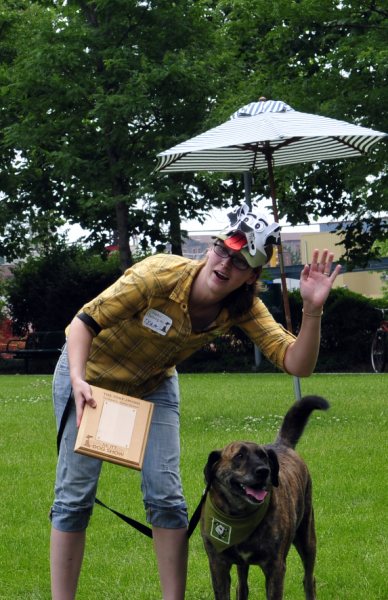
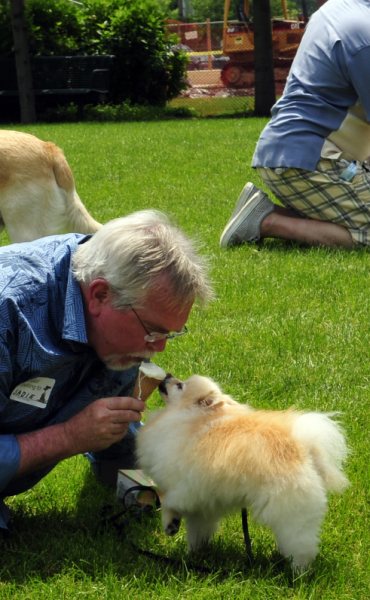
Thanks to Tom Carroll of Preservation Pottstown for the hot-off-the-press photos!

Registration
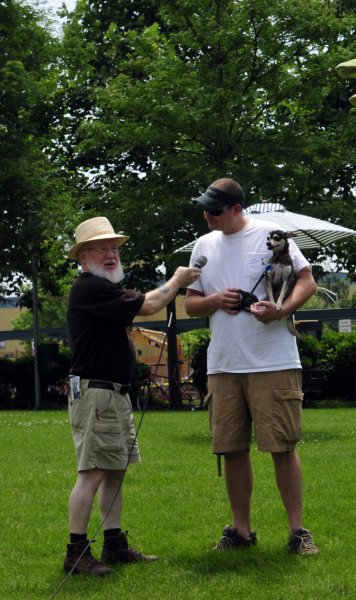
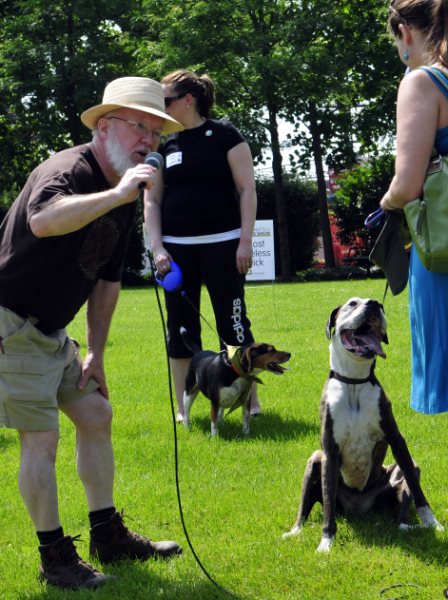
Here are a few glimpses of today’s First Saturday festivities at Smith Plaza, where the first annual PottsMUTTster dog show was held. I don’t have details on the winners in the many categories, or the grand winner, who will appear in the 4th of July parade… stay tuned!
Erica & friend

Sharing a cone with man's best friend!

Unlikely pair?
Warren & a contender

Pottstown’s Weekend – lots going on!

Please check out the calendar page at Positively!Pottstown for a line-up of happenings starting tonight and moving through the weekend. Dance the week’s frustrations away at Sunnybrook tonight… tomorrow morning, get up early, grab your work gloves and a trowel and take part in a community garden project at Washington & Chestnut Sts…. grab a cool drink and a bite to eat for the volunteers… head over to Smith Plaza, kick off your sweaty socks, literally slap some paint on an old car (trust me, it feels so right) and catch some music at the First Saturday Celebration… head home to shower… give in to the urge to skip cooking for one night and go back into town for dinner… go see Ragtime at Tri-PAC… wake up on Sunday energized after the awesome day you had the day before… stop by Memorial Park at 1 pm to see an interesting tradition in the burning of retired flags… It’s only 2 pm on Sunday afternoon, and there’s still plenty of time to do whatever you thought you were going to do before you got caught up in living in the moment…

I’ll be tending to stuff like this across the river here, but just might get to the matinee of Ragtime on Sunday afternoon. Have a great weekend!

Blog at WordPress.com.

Up ↑