Trilogy Park in Pottstown hosts national BMX event Memorial Day weekend

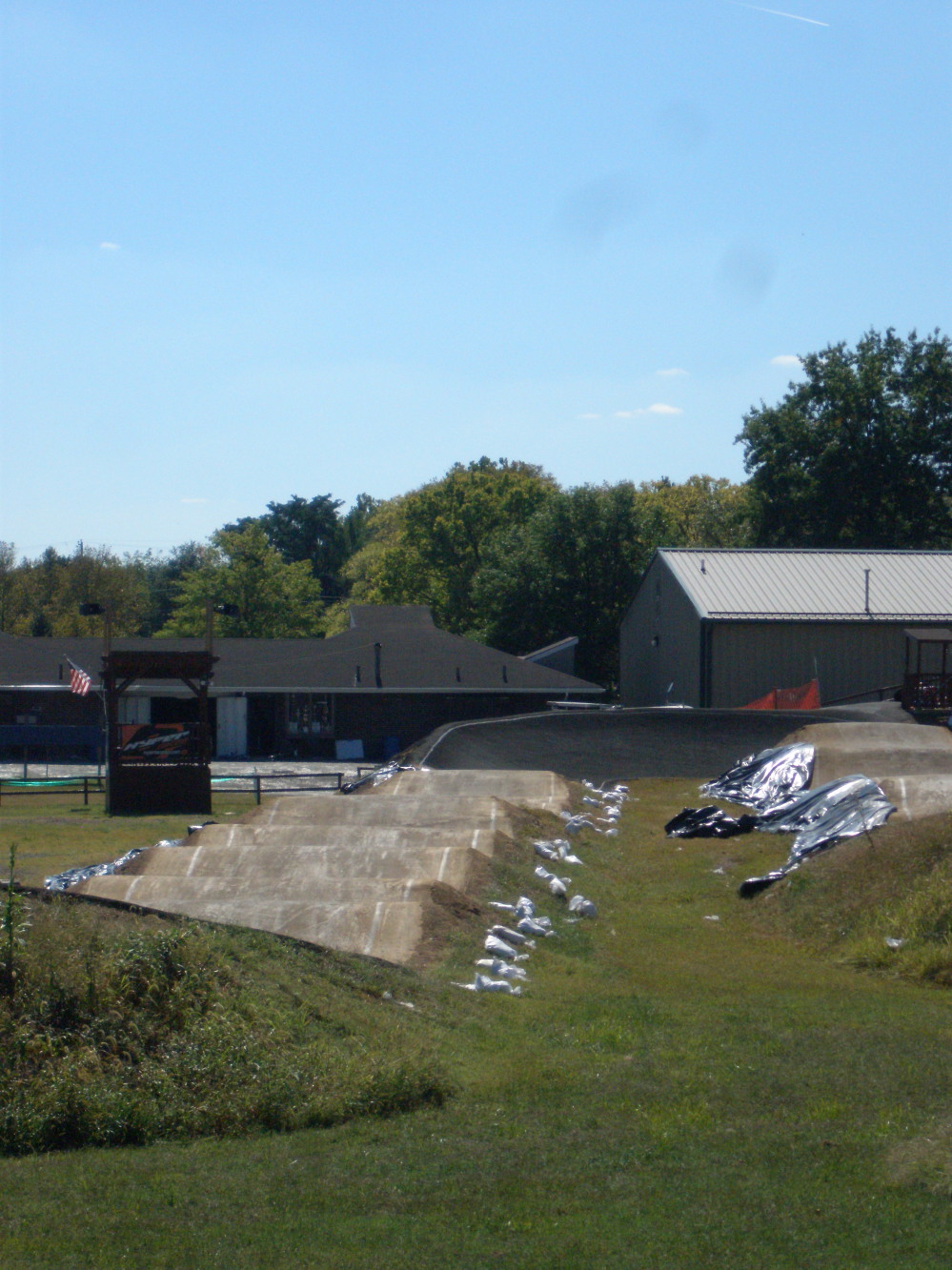
 Did you know that Pottstown is home to Trilogy Park, a BMX, inline, and skateboard park that hosts a national event each Memorial Day weekend?

Trilogy Park is in Memorial Park at the site of the former Gruber Pool. This year the Memorial Classic is expected to bring between 3,000-5,000 visitors, depending on weather, from as far away as Florida and the Midwest. Each year this event has grown because of the tireless efforts of Pottstown residents Cathy and Glen Knapper and other parent volunteers, and it has gained a reputation as one of the premier events on the National Bicycle League (NBL) circuit.

This is an awesome opportunity for Pottstown to showcase its incredible Parks and Recreation Department and the equally amazing Memorial Park.

I had seen the BMX track last year when I was investigating and writing the parks blog series for the Pottstown Area Health & Wellness Foundation. Even afterwards, though, I didn’t quite know what it was all about, never having gone to a race.

BMX stands for Bicycle Motocross Racing. It involves biking over a dirt course with jumps and turns. Riders wear a helmet, long pants, long-sleeved shirt and closed-toe shoes. Bikes are inspected before each race for safety. Competitors practice the course as much as they can before the race so they’re familiar with the starting gate, obstacles and the turns. Each track posts moto-sheets on a moto-board; this is where riders can find out their number and gate lane for a race. BMX is open to all ages, from toddlers to the over-55 crowd.

The schedule for the Memorial Classic can be found here.

In general, bike inspections and practices by age group begin at 1:30 pm on Friday. A pre-race for local riders who will not be competing in the national races will take place at 6:30 pm.

On Saturday, inspections and practices begin at 6:30 am; opening ceremonies take place at 10:45 and races begin at 11 am and will run until about 4 pm.

On Sunday, there will be NO bike inspections or registrations. There are a few practices scheduled by age group, beginning at 7:30 am. Then racing gets underway at 8:30 am and will run until about 1:30 pm. 

A really special part of this year’s event will be the arrival of the Warren family from Florida in Pottstown on Thursday, May 26th. Neva“The BMX Diva” and her parents, Tammy and Jay, are biking to all the National BMX events this year and blogging about it at www.ridethenation.org. They started their journey on April 20th inTampa and will keep going until they get to the Grand National Championship inLouisville, Kentucky on Labor Day weekend. We’ll be featuring them in an upcoming post and talking about BMX and the Memorial Classic for the rest of the week, so stay tuned! “Like” Trilogy Park on Facebookto keep up with all the latest news, or call the TRACK HOTLINE at 484.363.0592.

Tri-County for A Cure Video Project

The weekend is finally almost here for Yoga on the Steps, which benefits the amazing organization: Living Beyond Breast Cancer.  In case you weren’t able to attend our last Positively!Pottstown Happy Hour and you haven’t seen this video circulating around the internet (especially on facebook), here’s the culmination of some fun ideas, a lot of great participation by local business owners and leaders, and the talent of a certain photographer, Melia Rios-Lazo of Priceless Moments

Owner of High Street Yoga and the creative force behind the video, Barbara Kosciewicz offered her thoughts today about the video.  She writes of the project:

Throughout the long winter, during each class someone would comment or giggle about a certain pose we could do in a location in Pottstown.  We dreamed for spring to come and decided it would be our spring project.   Before long, the idea began to grow and evolve into raising awareness and funds for our Yoga team Tri-County for a Cure that is attending Yoga on the Steps on Sunday May 15th. Suddenly the project became much  greater than ourselves and became something both fun and meaningful

You can read the rest of her thoughts on her blog, Yoga Wisdom for Everyday, which is also a Mercury Town Square Blog. 

There is still time to get involved with Yoga on the Steps:  you can donate to the Tri-County for a Cure team or even sign up to participate on Sunday.  Just visit www.yogaonthesteps.org to get the details.

Happy Mother’s Day and Happy Spring!

Wishing all the moms a Happy Mother’s Day and Happy Spring to everyone! Be sure to set aside some time to get outdoors with your loved ones today or for some quiet time yourself. For information about parks and recreation in the region, check out our Parks & Rec Series, sponsored by the Pottstown Area Health & Wellness Foundation. For more tips on healthy living, visit them online at www.missionhealthyliving.org.

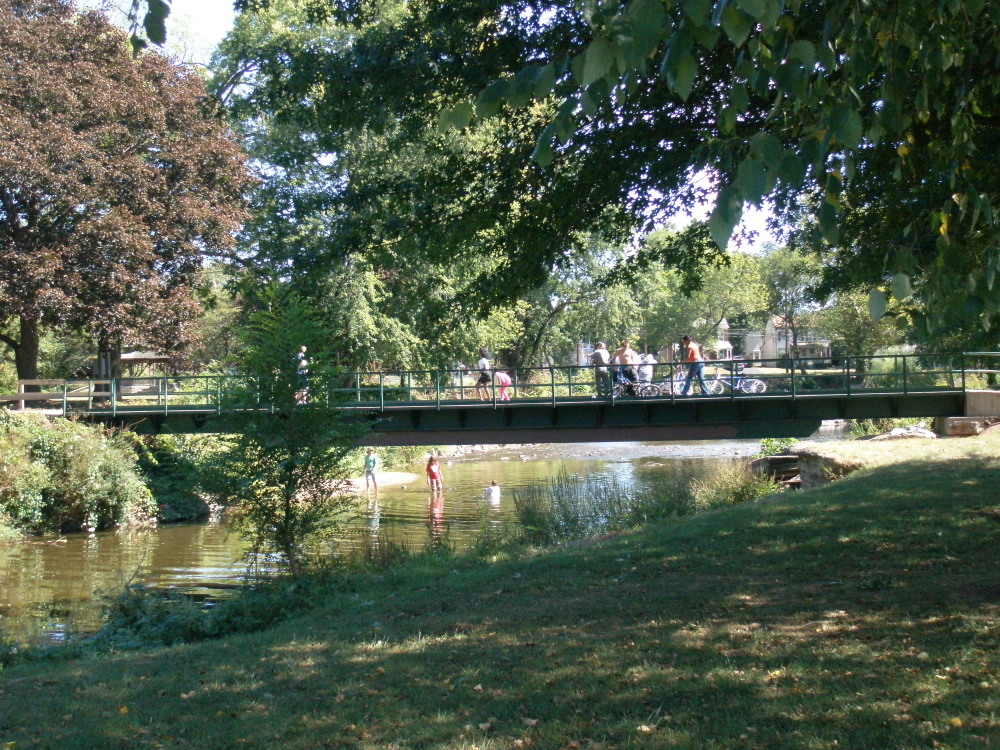
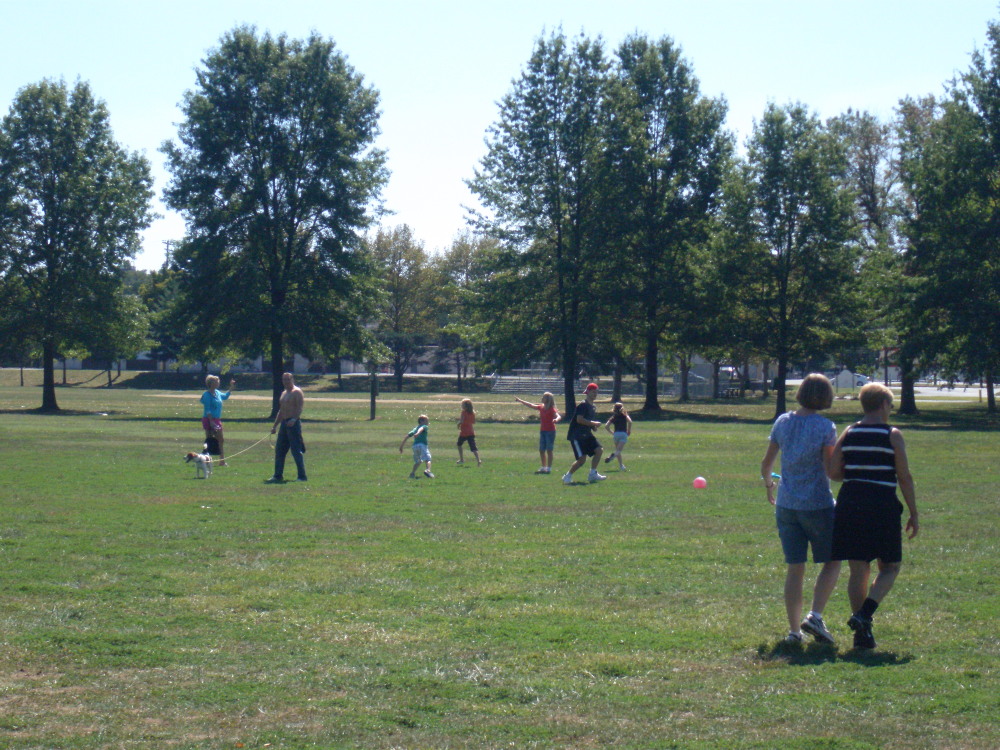
Memorial Park, Pottstown
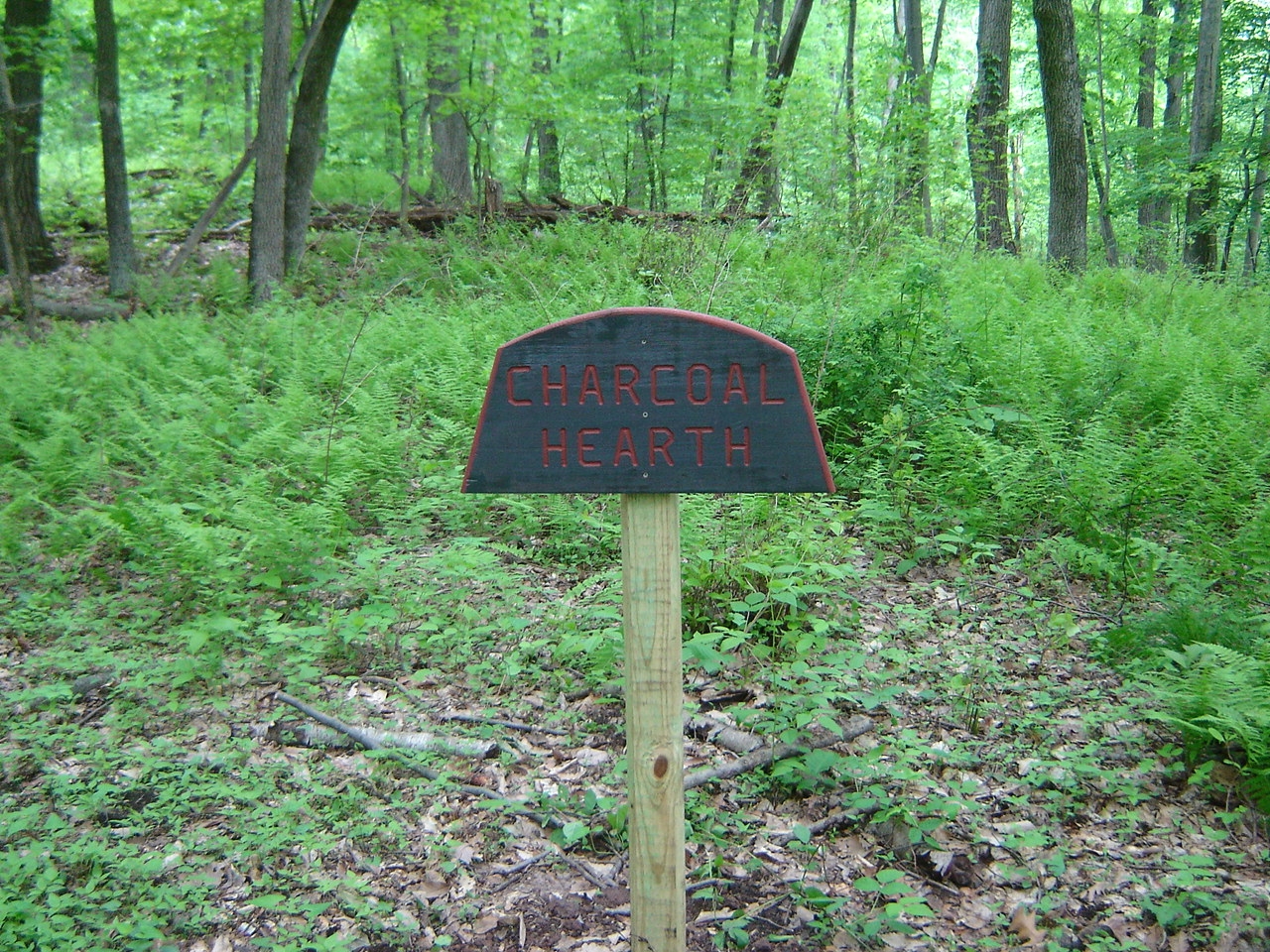
Coventry Woods, North Coventry
Mocharniuk Meadows, Upper Pottsgrove

Tri-County for a Cure Team Gets Ready for Yoga on the Steps

If you’ve seen a bunch of women dressed in black yoga garb and pink bandanas running around downtown Pottstown in the last few weeks, you aren’t imagining things and we aren’t being invaded by pink ninja yogis.

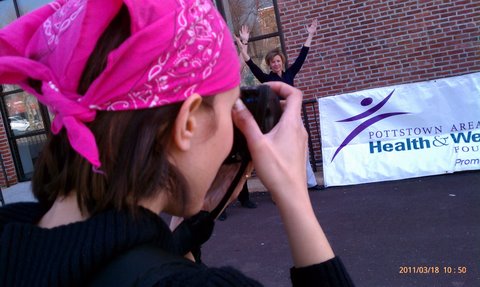
It’s the Tri-County for a Cure team, headed up by local yoga instructor, Barbara Kosciewicz of High Street Yoga and filmed by photographer Melia Rios-Lazo, of Priceless Moments Photography. I am lucky enough to be one of these team members, and we’re busy getting ready for the Yoga on the Steps fundraiser for Living Beyond Breast Cancer that will be held in Philadelphia on May 15th.

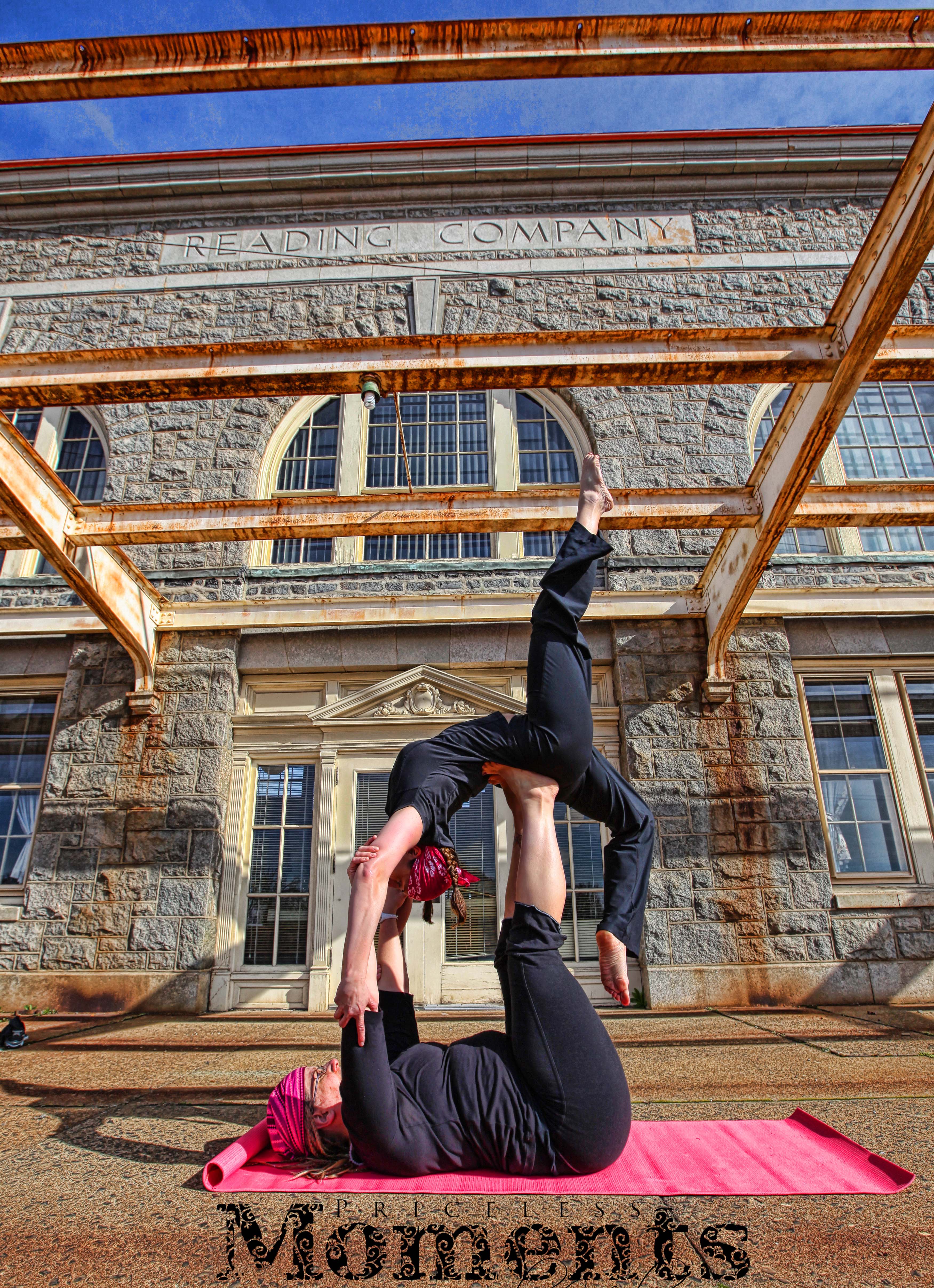
Image by Melia Rios-Lazo from Priceless Moments Portrait

Last year’s event drew over 1,200 yoga enthusiasts to the Art Museum in Philadelphia to do yoga and raise money for Living Beyond Breast Cancer, a non-profit dedicated to support services for women in treatment and beyond. While many breast cancer organizations focus on finding a cure, LBBC is different. According to their mission statement, their goal is, “To empower all women affected by breast cancer to live as long as possible with the best quality of life.”

Kosciewicz found out about the Yoga on the Steps event late last year and got a couple of friends, jewelry artist Carrie Grabowicz of Hammi Jammi Jewelry and Joy van Ruler, an artist who designed this year’s team logo, to join her on the steps of the Art Museum. This year, the team has 20 registered members and there is room for more. Fellow yoga instructor, Stephanie Smolik of Yoga-for-Every-Belly, is a team member as well.

So, what does all this have to do with pink-headed yogis running rampant through the streets of Pottstown and encouraging business owners, the mayor and borough manager to strike a yoga pose?  Actually quite a bit. The excitement was all about the video the Tri-County for a Cure team is making to raise awareness about breast cancer.   

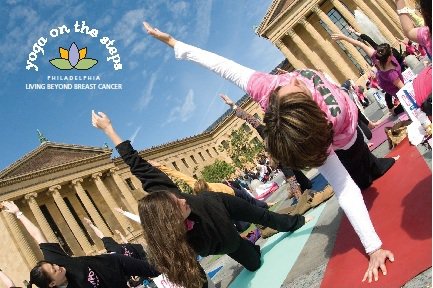
Image from Living Beyond Breast Cancer

The impetus for the video was a conversation before one of Barbara’s classes about how funny it would be to do yoga in random places around town. Before long the idea had grown to involve raising awareness and funds for the Yoga on the Steps event and the team, Tri-County for a Cure.

Honestly, the first day of filming, I think many of us (myself included) were a little nervous about the idea of being filmed or photographed in yoga poses, but with Melia’s enthusiasm and skill, we all quickly got into the spirit of the day. Before we knew it, we were sitting in prayer squat near the door of a Septa Bus in front of Borough Hall.

We had a schedule, but also grabbed unsuspecting people along the way, and I was amazed at the support we found. We even convinced the UPS driver to pose with us near the police station, and some college kids on the steps at Montgomery County Community College.

“We attracted attention, beeps and awareness. Everyone we came in contact with was supportive of the cause and gave yoga their best shot,” said Kosciewicz. “We talked to people who were survivors, who had family members that were survivors or had lost someone to breast cancer.” 

She continued, “At the end of each day filming I walked away energized, but also with the understanding that Breast Cancer is a terrible disease and something that has affected everyone. I would use the word ‘powerful’ to describe the filming days.”

Even Positively Pottstown’s own Sue Repko joined us at Riverfront Park for some quiet meditation on the last day of filming. We also got Borough Manager Jason Bobst, The Schuykill River National and State Heritage Area staff, and most of the Pottstown Health and Wellness Foundation staff out to do yoga on that 70 degree Friday we enjoyed a few weeks ago.

photo by Lisa Engle

The whole experience was, well, something amazing to experience.  We got so many people to come out of their stores, offices, and comfort zones and be a little silly with us for an important cause. Barbara summed up the days’ filming this way (and I agree wholeheartedly): “I enjoyed the interaction with each and every person; the willingness of EVERYONE to do something for breast cancer and for Pottstown’s revitalization.”

The video is set to debut at the next Positively Pottstown Happy Hour on April 15th at the Academy of Massage Therapy and Bodyworks and High Street Yoga, which shares the space on the second floor of the massage school.

For information about the event in May, or to learn more about the organization’s services and mission, you can visit Living Beyond Breast Cancer’s webpage at www.llbc.org

If you can’t wait till April 15th for the video and want a sneak peek of the coverage, you can check out the Mercury’s coverage of the day, or visit the Tri-County for a Cure facebook page for links to the local news stories that ran about the filming

Heritage Action Plan needs your input!

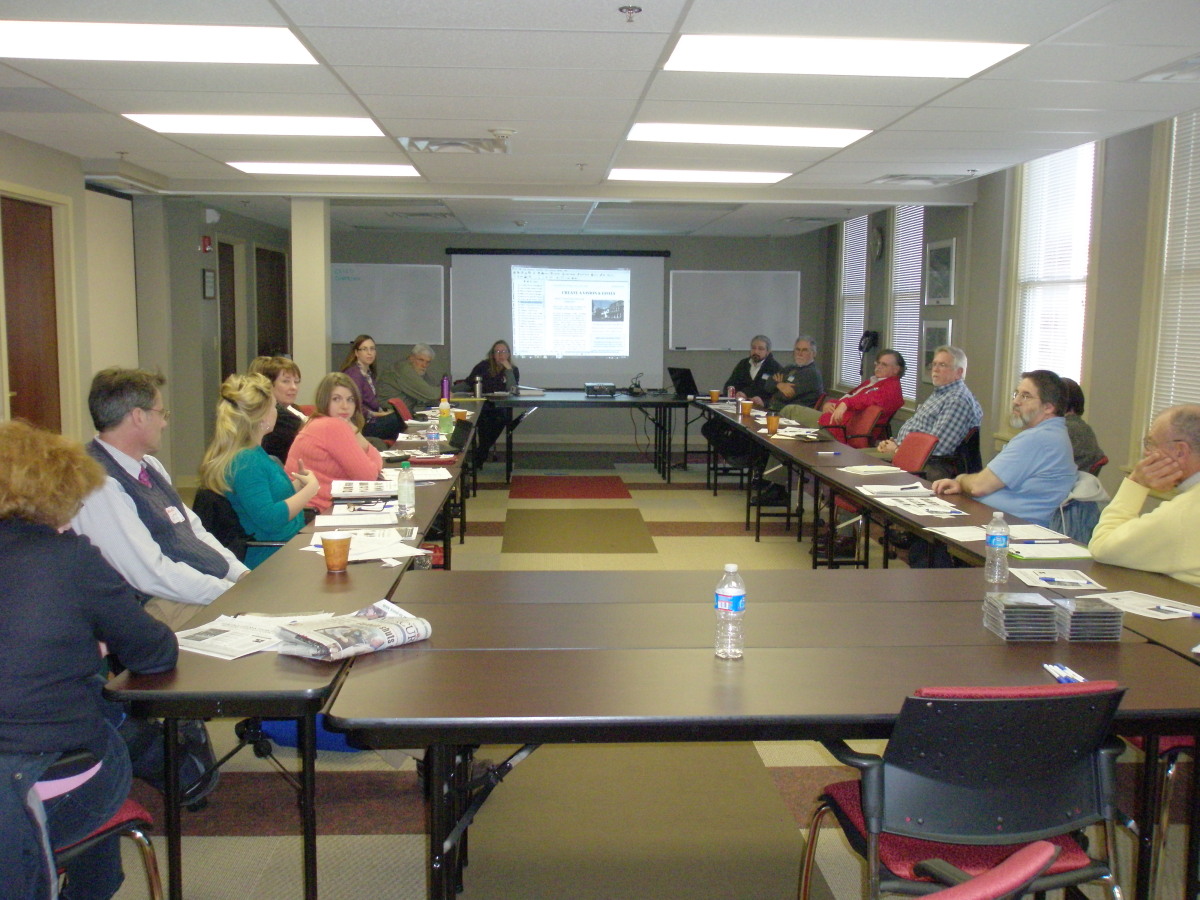
Last Friday, about 20 individuals and representatives from many different organizations in the community gathered at the Tri-County Area Chamber of Commerce for a 3.5 hour workshop to really dig into Pottstown’s Heritage Action Plan. Pottstown is creating a Heritage Action Plan or HAP with funds from the Schuylkill River Heritage Area (SRHA). The purpose is to come up with a plan that will help promote and protect Pottstown’s heritage resources, make it a destination location and promote economic development.

On hand were Bob Folwell and Kara Wilson from the SRHA, as well as heritage planning consultants Shane and Peter Johnston from Peter Johnston Associates of Easton, MD. They were there to give an overview of the heritage planning toolkit, which they developed and which is being used to guide Pottstown through the process.

Our first step had been reaching out and trying to find “partners” to participate. A partner can be just about anyone, from an interested citizen to the Pottstown Area Health & Wellness Foundation, the Tri-County Performing Arts Center, The Hill School, the Pottstown Community Land Trust, or local blogger Roy Keeler. I have gotten back partnership forms from several participants. To anyone else who would like to be an official partner: please get me your forms by this Friday, March 11! The Partnership_Form can be accessed here for anyone reading this for the first time.

After forming useful partnerships, the next step from the toolkit is creating a vision and goals. On Friday, we went around the room and people shared their vision for what the town could look like and feel like in an ideal world, while consultant Shane Johnston typed away. We came up with some common themes, which will be posted here shortly. We will also open up that conversation to the public for more input.

The next major step from the toolkit is to identify and assess a community’s heritage resources. Before we can market Pottstown, we need to catalogue exactly what resources we have and then decide which ones will provide the most immediate, visible return if we spend money to promote them. When this HAP is completed in April, we will apply for $25,000 to the SRHA to implement those top priorities over the course of the next year.

In an effort to bring the wider community into the conversation, we are putting out a request for help in identifying Pottstown’s “heritage resources.” Readers are welcome to respond here or at our Facebook page: Pottstown Heritage Action Plan.

So, what exactly is a “heritage resource”?

Here are a bunch of categories and some examples to get you thinking:

Historic Sites/Structures
– Downtown historic walking tours
– Potts Cemetery
– Edgewood Cemetery
– Various war memorials

Archeological Sites/Structures

Cultural Sites (Churches, Synagogues, etc.)
– Any historic church in town

Educational Institutions and Libraries
– Pottstown Historical Society
– Pottstown Regional Public Library

Museums & Other Interpretive Centers

Arts, Entertainment, and Shopping Areas

Major Highways and Roads

Trails, Greenways, Bikeways, Railroads

Sensitive Environmental Areas, Natural Wonders

Parks and Recreation Areas
– Riverfront Park
– Memorial Park

Tourism Dependent Businesses (hotels, restaurants, bars)

Special Events/Festivals that highlight local history/culture
– Schuylkill River Festival
– Carousel of Flavor
– July 4th
– Volleyball Rumble

Tourist Facilities (public restrooms, parking)

Other Resources

WE NEED YOU TO JOIN THE CONVERSATION
What are some of Pottstown’s resources that you’d like to see on the list? As people respond, I’ll periodically update the list. Because of our short time frame to complete the plan, it would be great if people could get their suggestions in by this Friday, March 11th. If you have any questions, or would like to be involved further, send an email to PtownHAP@gmail.com Thanks for participating!

Fourth & final article in series on childhood obesity

Note: This is the final article in a four-part series on Childhood Obesity presented by the Pottstown Area Health & Wellness Foundation. Corresponding Webisodes are available for viewing on www.missionhealthyliving.org. This final article focuses on what parents and children can do to start to change their habits, lose weight and live healthier lives.

CHILDHOOD OBESITY: WHAT CAN PARENTS DO NOW

TO HELP THEIR CHILD FIGHT OBESITY?

By: Dr. Laurie Betts, Program Officer, Pottstown Area Health & Wellness Foundation

A recent White House Task Force on Childhood Obesity Report to the President, Solving the Problem of Childhood Obesity Within a Generation, released some startling information—childhood obesity has become an epidemic in America and it is now considered a national health crisis. If your child is already overweight or on his or her way to becoming overweight, now is the time to take action. The effects obesity can have on your child’s emotional and physical health, both in the short- and long-term, can be devastating. Making changes in your child’s life that will affect his or her health and weight positively can be difficult, and at first appear overwhelming. You may not even know where to begin, but there are easy ways to take small steps that will equate to big changes in your child’s future.

There are a number of factors that can contribute to a child being overweight, including frequently eating a high-calorie diet, not getting enough exercise, family history, psychological issues and family dynamics. In addition to these factors, there are definite warning signs you can watch for that could indicate your child is already overweight or on the path to becoming obese including weight gain, inactivity or lethargy, depression, meal skipping, obsessions with food and continual snacking.

Steps To Take

As a parent, you have the most influence over your child’s eating habits. One of the most important first steps you can take is to commit to change as a family. Embarking on this journey as a family will enable long-term success because what you do will become a way of life in your household and constantly be reinforced. Remember, parents help build and shape lifelong eating patterns and children are likely to model the food and meal rituals of their families.

First, if your eating habits are less than perfect, don’t stress—bad nutritional habits can be changed. It is important to set the example, however. Secondly, it is imperative that parents set down some rules in regard to how their children view food. Do not use food as a reward, punishment or as a way to handle emotions. Finally, you want to teach your child the importance of healthy eating both at mealtimes and at snack time. Teaching your child how to satisfy cravings with options that are low in fat and contain simple sugars—sugars that are found in fruit rather than sugary snacks—are lessons that will last a lifetime. Taking the time to talk with your family and then incorporating the benefits of eating better into your lives will also go a long way. Good rules to follow for nutritional eating include:

• Limit sodas or high-sugar drinks

• Eat more fruits and vegetables

• Increase physical activity

• Eat more protein, nuts and leaner meats

Other things you can do as a family to help correct or prevent obesity include:

– Make an appointment to see the family doctor or pediatrician to get additional up-to-date-advice

on fighting childhood obesity.

– Record what your child eats and drinks for a week to show the doctor.

– Check out websites that have nutritional and exercise information you can use like

www.mypyramid.gov, www.nourishinteractive.com, www.letsmove.gov, and

www.missionhealthyliving.org.

– Make wise choices and keep only healthy food in the house.

– Severely limit sweet and fattening snacks, desserts and beverages.

– Don’t use food as a reward or a punishment.

– Stop eating out at fast food restaurants.

– Eat together as a family as often as possible with the focus on conversation; take your time

at meals and make them a relaxed and close family time.

– Exercise with your kids on a regular basis.

– Restrict TV and recreational computer time to a maximum of two hours a day.

– Lead by example, adopt good eating habits and exercise regularly—together.

– Teach your children how to handle negative emotions without using food. For instance, if he or

she is upset suggest a walk, listening to music or have them draw or write about what they are

feeling.

Changing the way your child and your family thinks about food does not have to happen all at once. Make a list of goals you want to achieve as a family to get healthy and lose weight. Choose one or two goals each month to incorporate into your daily living. The most important part of setting these goals is to choose something small enough that you can commit and stick to it. Start slowly and don’t overwhelm yourself, but keep your commitments even when it’s not convenient. Over a matter of months, you will start to see results and start to feel great about what you are doing for yourself and your family.

To learn more about the warning signs, risk factors and solutions to childhood obesity, plan on attending the free seminar sponsored by the Pottstown Area Health & Wellness Foundation on Thursday, January 13, 2011, 7:00-8:00 PM at the Pottstown Senior Center, 724 North Adams Street, Pottstown. Dr. Laurie Betts, Program Officer for the Foundation, will discuss the trends, causes and health implications of childhood obesity, and practical steps you can take to reverse or prevent this serious condition. You will also hear about local programs that can aid in the prevention of childhood obesity. To register, please call Rose Crews at 610-323-2006 x21 or email her at rosecrews@pottstownfoundation.org.

About the Series – Childhood Obesity This four-part article series was developed by the Pottstown Area Health & Wellness Foundation. Corresponding Webisodes featuring local experts can be found on http://www.missionhealthyliving.org. The first article discusses how childhood obesity has become a national epidemic. The second article focuses on the warning signs and risk factors of childhood obesity. The third article talks about what schools are doing across the nation, the state of Pennsylvania and in Greater Pottstown to combat childhood obesity.

About the Foundation The Pottstown Area Health & Wellness Foundation’s mission is to enhance the health and wellness of area residents, providing education, funding and programs that motivate people to adopt healthy lifestyles. Visit www.pottstownfoundation.org for more information about the Foundation. Discover Pottstown area’s new online community at www.missionhealthyliving.org to learn and share great information on how to lead a healthier life!

Third article in series on childhood obesity

Note: This is the third article in a four-part series on Childhood Obesity presented by the Pottstown Area Health & Wellness Foundation. Corresponding Webisodes are available for viewing on www.missionhealthyliving.org.

CHILDHOOD OBESITY: WHAT ARE SCHOOLS DOING ON A

STATE AND LOCAL LEVEL TO FIGHT THE EPIDEMIC?

By: Dave Kraybill, Executive Director, Pottstown Area Health & Wellness Foundation

Back in 2004, The Child Nutrition and Women, Infants and Children Reauthorization Act required that all education agencies develop wellness policies to address childhood obesity by the start of the 2006-2007 school year. Districts nationwide had to create at least one goal to improve wellness in the following categories: nutrition education, physical activity, availability of nutrition guidelines to students, and other school-based activities to address student wellness.

“Pennsylvania was one of the few states that actually collected and analyzed plans to ensure they addressed this problem of childhood obesity,” said Elaine McDonnell, projects coordinator, Project PA. “If school districts [in Pennsylvania] sent goals that did not meet state standards, the schools had to rework those plans.” Project PA was a collaboration between Penn State University’s Department of Nutritional Sciences and the Pennsylvania Department of Education, Division of Food and Nutrition. The team partnered with schools and their communities to provide sound nutrition education and to promote children’s healthy eating behaviors.

Pennsylvania school districts set goals and improved snacks and a la carte offerings to meet this required federal legislation for reducing childhood obesity. The state’s multi-faceted approach included mandatory training sessions for all school food service directors and financial incentives to schools that adopted state-created nutrient standards for the a la carte food items offered at the school. Ultimately, nearly all school districts worked with the state to formulate plans that would target obesity in some way. While Pennsylvania schools addressed and improved the food available through vending machines and a la carte offerings, they still were missing opportunities for physical activity, which did not improve.

A recent White House Task Force on Childhood Obesity Report to the President, Solving the Problem of Childhood Obesity Within a Generation, released some startling information—childhood obesity has become an epidemic in America and it is now considered a national health crisis. The report presents a series of specific recommendations, two of which involve school involvement—providing healthy food in schools and getting children more physically active through physical education, recess and other after-school opportunities.

Currently, the Pennsylvania Department of Education has new legislation in draft form under Chapter 12 that, if passed, will require schools to establish and maintain wellness committees to assess, plan and implement, monitor district and school health and wellness policies and programs. This will include setting up goals and measuring success in the areas of nutrition and physical education at the elementary, middle and high school levels.

What Are Our Local Schools Doing?

The local school districts have been involved in addressing childhood obesity on a state level for many years. However, the local schools in Pottstown and those within a 10-mile radius have another advantage that most schools in Pennsylvania, even the nation, don’t have—grant funding available through a Foundation.

The Pottstown Area Health & Wellness Foundation provides grants, programs and educational resources to the Pottstown Area to enhance the health and wellness of area residents—but that did not include giving grants to schools in the very beginning.

“Initially, we weren’t sure if we should fund a public entity,” comments Sharon Weaver, Board President, Pottstown Area Health & Wellness Foundation. “But, we soon realized that schools could be instrumental in furthering our vision.  All school districts, public and private, have initiated creative programs that continue to directly hit one of our target audiences—children.”

“We as a community have been very fortunate that our area school districts have embraced health and wellness, which includes addressing the problem of childhood obesity,” remarks Dave Kraybill, Executive Director, Pottstown Area Health & Wellness Foundation. “The schools have consistently and creatively submitted grant requests for programs and projects that have been effective and well received by the students, teachers, parents and community. We thank them for their continued efforts and dedication to improving the health and wellness of our youth.”

There are many area schools using grants from the Foundation to improve the health and wellness of students. For more information about the programs offered for students and parents, please go to the school’s website.

School: Boyertown

Grants: Healthy Hearts and Minds, Revise Recess

For More Information: http://www.boyertownasd.org

School: Daniel Boone

Grants: Healthy for a Lifetime

For More Information: http://www.dboone.k12.pa.us

School: Owen J. Roberts

Grants: Fit for Life

For More Information: http://www.ojrsd.com

School: Perkiomen Valley

Grants: Creating Healthy Opportunities for Students, Comprehensive Adolescent Fitness Program

For More Information: http://www.pvsd.org

School: Pottsgrove

Grants: Wellness Center Project, Walk4Life, Dance Dance Revolution, SNAP, Five for Life Program, SNAP Academy

For More Information: http://www.pgsd.org

School: Pottstown

Grants: Safe Schools/Healthy Students, Healthy Snack Program, CATCH Kids Club

For More Information: http://www.pottstownschools.com

School: Spring-Ford Area

Grant: Healthy Choices Project

For More Information: http://www.pvsd.org

School: Blessed Theresa of Calcutta School, Schwenksville

Grant: Gymnasium Building Project for students K through 8

For More Information: http://www.blteresacalcutta.com

School: Coventry Christian School

Grant: Nutrition Curriculum Enhancement

For More Information: http://www.coventrychristian.com

School: Perkiomen Valley Academy

Grant: H.E.A.L. – Health & Emotional Alternatives for Life

For More Information: http://www.pvsd.org

School: Sacred Heart School, Royersford

Grant: Health and Wellness

For More Information: http://parish.sacredheartroyersford.org

School: St. Aloysius School

Grant: Fitness, One Step at a Time

For More Information: http://www.saintaloysius.net

School: West-Mont Christian Academy

Grant: Fitness Training Room, Healthy Snack Program, Fresh Fruit & Vegetable Program

For More Information: http://www.west-mont.org

About the Series – Childhood Obesity This four-part article series was developed by the Pottstown Area Health & Wellness Foundation. Corresponding Webisodes featuring local experts can be found on http://www.missionhealthyliving.org. The first article discusses how childhood obesity has become a national epidemic. The second article discusses the risks, warning signs and long-term effects of childhood obesity. The final article will focus on what parents and children can do to start to change their habits, lose weight and live healthier lives.

About the Foundation The Pottstown Area Health & Wellness Foundation’s mission is to enhance the health and wellness of area residents, providing education, funding and programs that motivate people to adopt healthy lifestyles. Visit www.pottstownfoundation.org for more information about the Foundation. Discover Pottstown area’s new online community at http://www.missionhealthyliving.org to learn and share great information on how to lead a healthier life!

Second article in series on childhood obesity

Note: This is the second article in a four-part series on Childhood Obesity presented by the Pottstown Area Health & Wellness Foundation. Corresponding Webisodes are available for viewing on www.missionhealthyliving.org.

CHILDHOOD OBESITY: THE RISK FACTORS, WARNING SIGNS AND LONG-TERM EFFECTS

By: Dr. Laurie Betts, Program Officer, Pottstown Area Health & Wellness Foundation

Too often, parents make excuses why their child is overweight, or worse, not even realize that their weight is becoming a problem. “It’s baby fat, she’ll out grow it.” “He’s just a good eater.” “She is just big-boned.” “His dad is big too, it’s in the family.” Unfortunately, ignoring the warning signs that your child is gaining weight or is already obese can have significant effects on their current and future physical health and surprisingly, their psychological health, too.

A recent White House Task Force on Childhood Obesity Report to the President, Solving the Problem of Childhood Obesity Within a Generation, released some startling information—childhood obesity has become an epidemic in America and it is now considered a national health crisis. The report goes on to say that the epidemic of childhood obesity is costing more than $3 billion a year in direct medical expenses and that is likely to rise if not stopped. According to the Institute of Medicine of the National Academies, approximately nine million American children over six years old are considered obese. In addition, one study found that obese six to eight year-olds were approximately ten times more likely to become obese adults than children with lower body mass indexes (BMI).

It is not considered normal for a child to be overweight. It is important that parents take the responsibility to feed their children healthy foods and monitor their intake in the early years, so that good eating habits stay with them for life. However, all too often, it is easier to let children self-monitor what they are eating due to their or your schedule. The reality is that parents need to be just as concerned about what their children eat as they are about teaching them not to get into cars with strangers.

Risk Factors for Childhood Obesity
There are a number of factors that can contribute to a child being overweight; in fact, the tendency can actually start before birth. If the mother uses tobacco, gains excessive weight or has diabetes, her child has an increased risk of being obese during the preschool years. If the child has a higher birth weight, has rapid weight gain in the first year of life or develops body fat in the preschool years, he or she has an increased risk of being obese by age seven.

Other risk factors include:
Diet – regularly eating high-calorie foods such as baked goods, fast food, fried food, vending machine snacks, sugary drinks, candy and desserts can easily cause a child to gain weight. All these foods lack significant nutritional value and are high in sugar, fat and calories.

Lack of exercise – children tend to spend more time in front of the TV, the computer and video games and less time outside playing sports, walking and riding bikes. Children who do not exercise much are likely to gain weight because they are not burning enough calories.

Family history – if the child comes from a family of overweight people or if one or both parents are obese, he or she is more likely to put on excess weight, especially if the parents do not eat well and high-calorie food is always available and exercise is not encouraged.

Psychological factors – children can overeat due to stressful school or home life situations. They also can turn to food to cope with any strong emotions or problems, or to fight boredom.

Family factors – parents buy the groceries, and if they are buying high-calorie or convenience foods, this is probably contributing to a child’s weight problem. Parents should limit the child’s exposure to these types of foods.

Socioeconomic factors – children from low-income backgrounds are unfortunately at higher risk. It takes both time and resources to make healthy eating and exercise a family priority.

Warning Signs
In addition to the risk factors for childhood obesity, there are definite warning signs a parent can watch for that could indicate your child is already overweight or on the path to becoming obese.

1. Weight gain – this is definitely a sign that your child is probably not eating correctly, especially if your child is a teenager. Teens are usually in a growth phase, and they should be absorbing energy from their food, not putting on unnecessary pounds and getting obese.

2. Inactivity – if your child starts to become overweight, he or she will most likely become less active and lethargic. Children need to be active in order to develop properly. The amount of physical education they get in school is not enough. Exercising as a family can help assure your child is getting enough physical activity.

3. Depression – this is a very serious condition, and if you are concerned your child may be depressed, always seek professional help. Depressed children often overeat, seeking solace in food. This can lead to obesity and eating disorders.

4. Improper Eating – if children are not eating the healthy meals you’ve prepared, there is a good chance they have been snacking on junk food during the day or after school.

5. Meal Skipping – this could lead to binging or digestive problems. It is important to discourage children from skipping a meal because it will not help them lose weight, but it could actually lead to weight gain.

6. Food Obsession – when your child starts to turn to food instead of friends and family for support or comfort, this can be an unhealthy association and lead to obesity, as well as other problems.

7. Continual Snacking – this is a bad habit that will follow children into adulthood. Have healthy snacks on hand for after-school treats. It will help alleviate hunger pangs, but offer nutritional value.

Short- and Long-Term Health Effects
Ultimately, being overweight as a child puts the child at increased risk for having problems, both in the short term and the long term, with the child’s physical, social and emotional well-being.

Physical complications include:
– Type 2 diabetes
– High blood pressure and high cholesterol
– Asthma and other breathing problems
– Sleep apnea, a condition in which your child may snore, have abnormal breathing, or stop breathing while asleep
– Early puberty or menstruation due to hormone imbalances of being overweight at an early age
– Gallstones
– Liver problems

Social and emotional complications include:
– Suffering from low self-esteem and bullying
– Behavior and learning problems
– Depression

What Are We doing?
The Report to the President is hopeful that we are prepared to fight this epidemic through knowledge of the causes and risk factors for obesity. In addition, the report outlines what we can do as a country, as individual communities and as families to stop the epidemic.

In February 2010, Michelle Obama launched her Let’s Move initiative to the nation. It is designed to get healthier foods in schools, give parents support to make healthier choices for their children, and get families to be active together. For more information on this program, go to www.letsmove.gov.

The Pottstown Area Health & Wellness Foundation continues to make strides in changing the health habits of area residents. The Foundation funds programs and services through grants to area organizations and schools that focus on teaching children and their families to live healthier lives.

About the Series – Childhood Obesity
This four-part article series was developed by the Pottstown Area Health & Wellness Foundation. Corresponding Webisodes featuring local experts can be found on http://www.missionhealthyliving.org. The first article discusses how childhood obesity has become a national epidemic. The third article will discuss what schools are doing across the nation, the state of Pennsylvania and in Greater Pottstown to combat childhood obesity. The final article will focus on what parents and children can do to start to change their habits, lose weight and live healthier lives.

About the Foundation
The Pottstown Area Health & Wellness Foundation’s mission is to enhance the health and wellness of area residents, providing education, funding and programs that motivate people to adopt healthy lifestyles. Visit www.pottstownfoundation.org for more information about the Foundation. Discover Pottstown area’s new online community at www.missionhealthyliving.org to learn and share great information on how to lead a healthier life!

Blog at WordPress.com.

Up ↑