How one planner thinks

After months of getting pulled in closer, learning a lot, and meeting and talking with a lot of people, I’d like to now write more specifically about the planning, land development and community development challenges facing Pottstown. I’ll be writing with several different, intertwined perspectives in mind. The urban planning part of my brain is influenced by my point guard/leader/coaching brain, and it’s all (still) informed by the experiences of living in Pottstown, going up and down its streets in cars, on a bike, running or walking on my own two feet, during my formative years. I’ll try to show my thinking on the page, and in the process I hope to re-frame the way the community thinks about its challenges and what it wants to be, so that it’s better positioned to get there. If something doesn’t quite make sense or I’ve got a basic assumption all wrong, I apologize in advance. Let me know so I can re-assess things based on reality.

As to the title of this blog post… I’m going to lean heavily on a sports analogy here at the beginning. I see a connection between being a point guard in high school and college and then finding myself in the planning profession. A key concept & goal of the profession is to be comprehensive in outlook. And being a point guard means “seeing” and keeping track of everything that’s happening on the court.

Example: On a fast break, a point guard might not even know exactly who she’s passing to. She just sees the color of her teammates’ jerseys spread out in front of her. She sees opposing jerseys. She sees an open space that a teammate might move into, to get closer to the basket, and she tosses the ball to that space, believing her teammate will move to it, get the ball and score. You don’t want to make or encourage moves that have people crashing into one another. Teammates need to keep good spacing, but they do need to come together, say, when one sets a screen for another. They move closer together, then they move apart. It’s about seeing space and color and individuals working in concert. (Just re-read that… could almost describe a land use map too.) Ideally, it’s one big orchestrated dance that has spontaneity, too, based on trust and instinct.

On several different levels, I think about community development and comprehensive planning, at its best, as a series of orchestrated movements, where different people and groups are playing their roles to the best of their ability. The goals are reasonably attainable, based on the skills that everyone brings to the game. In hoops, you don’t want a schedule where you’re always losing and stuck in an unhealthy frame of mind. In community or economic development, you don’t want to set goals you can’t reach.

So let’s think of a really, really large court; let’s think of several bird’s eye views of Pottstown. A zoning map, historic district map, and homeowners’ initiative map all give a different view. Different uses, zones and priorities have been assigned to different spaces for specific reasons. Yes, these can be modified over time for many reasons. But no land use recommendations or decision should be made without regard to surrounding properties and the uses/priorities assigned to adjacent zones. Sounds simple, but in reality, it’s easy to get carried away from such a basic consideration.

I started writing what you’ve just read, after getting – ah, irked – at a July 31st Mercury article about an “energy plant” that comes with a landfill, proposed for the former Stanley G. Flagg site. The Mercury followed up with a glowing opinion piece on August 1st. But just because something comes in green wrapping paper doesn’t mean it’s good for a particular community.

From a bird’s eye view of Pottstown’s zoning map, I imagine truck after truck delivering municipal solid waste to a flex office zone that has parkland on one side and a narrow gateway zone and neighborhood residential on the other side. Parkland. Green Garbage. Gateway/Neighborhood Residential. This would be an example of incompatible uses crashing up against one another – in short, a badly run play.

I’m generally in favor of green initiatives! But every activity – even a green one – has to be considered in its context, in its specific location. And Pottstown has to start getting serious about how it markets itself. There are other green activities that it can explore and try to bring to town that don’t involve garbage at its western gateway. (We’ll get to these in this series, down the road a bit.)

Okay, so eventually, we need to print out a copy of the maps, come down out of the sky and see what’s exactly on the ground. It’s best to walk around with map in hand and get a sense of the scale of anything that’s already there or in the vicinity. There’s a whole other level of sensory awareness of what makes a “place” work. What do you see, smell and hear in a neighborhood or on a particular site? Does it feel safe?

When friends are looking for a new house in a new community, I advise them to stop in at the municipal building and visit the planning and engineering offices. Ask to see their maps and (here in NJ) the town’s Master Plan. Ask what’s going on. I also advise them to visit their potential new neighborhood at several different times during the day and night. Look for railroad tracks and airports; is there a lot of noise? Truck traffic? Commuter traffic? Bring the kids to the potential house, park the car, get out and walk to the park or school or ice cream shop together to see how it feels. Is it going to work for your family?

We’re all going to have our own opinions and different tolerance levels for all kinds of activities. But a town’s maps, and the ordinances that underlie and support those maps, represent existing public policy. Periodically, you re-evaluate them, you talk it out publicly and you might change them. You make exceptions only for very compelling reasons. To me, though, this is your starting point as a community. Your maps and your ordinances say who you are, how you want to grow, what you want your town to be.

Next up: Who’s doing the “work of the community?”

HB 712 – PA Land Bank Legislation

This afternoon I sat in on an hour-long webinar on proposed legislation that would enable the creation and operation of land banks in PA. The ability to create land banks would give all municipalities and counties a tremendous tool against blight and property abandonment. I could see a Pottstown Land Bank working hand-in-hand with The Pottstown Partnership, Genesis Housing and even PACA, offering homes for sale or lease-purchase throughout the Borough, marketing & offering housing and work space to artists (similar to Paducah, KY), attracting homeowners, entrepreneurs and businesses, and getting properties back on the tax rolls. But I’m getting ahead of myself.

The Housing Alliance of Pennsylvania sponsored the webinar. The presenters were Cindy Daley, Policy Director of the Housing Alliance, and Irene McClaughlin, an attorney and mediator who has spent her career dealing with blight-related issues in the Pittsburgh area. From the Alliance website: “Anti-blight land banking legislation passed the House on Tuesday, June 29, 2010 by a majority vote of 190-8. HB 712 provides for the creation of land banks for the conversion of vacant or tax-delinquent properties into productive use. The Housing Alliance supports this bill, although we anticipate it will need some technical amendments in the Senate.”

Below are some key points about what this legislation would allow and how a land bank would function. There are still questions about the nitty-gritty details, but with such overwhelming support in the House, it seems like this legislation could very well get passed in some form pretty soon. It is enabling legislation, which means that it allows land banks to be created but it’s up to individual towns and counties. It is NOT mandatory.

There are an estimated 300,000 vacant properties statewide. Between population and job loss and sprawl, rural, inner ring suburbs and urban communities have been faced with blight and abandonment.

An abandoned house or lot reduces the value of all other surrounding houses by an average of $6,720.

There might be potential buyers for these properties, but an inability to find the property owner, the lack of clear title, and debt that exceeds the property’s value all prevent a property from getting a new owner. Existing tools are inadequate: uncertainty of tax foreclosure process; cost & difficulty of condemnation; and existing laws, which have been on the books for decades never anticipated people simply walking away from property.

Land banks are single purpose entities created by local government to manage properties that no reasonable purchaser otherwise wants.

Would allow for the clearing of existing liens and old debt; clearing of title; remediation; assembly of parcels for current market conditions; holding of property until a market emerges; disposal or transfer under terms and conditions driven by the market.

Land banks just a part of a larger picture. Still need tax collection and foreclosure reform along with clearer mechanisms for protecting low-income homeowners or owners who simply wait until the last possible minute before paying their taxes. This enabling legislation – HB 712 – is just the beginning of the process.

Details of HB 712
Defines a Land Bank as a public agency.
Jurisdiction: Cities or counties that are authorized by state law to create a redevelopment authority. Any city or boro with 10K or more population.
Formed by an ordinance subject to approval by a mayor or county executive.
Intergovernmental Cooperation Agreement (ICA) between 2 or more land bank jurisdictions.
Smaller jurisdiction could join an existing land bank.
If there’s a land bank in a city and in that county, the county can’t take real property in that city.

Board of Directors
5-11 members (odd number); can include public officials and municipal employees.
Must include at least one voting member who is a community resident and a member of a civic organization, but who is not a public official or employee.
Must have open meetings, a regular meeting schedule and follow Sunshine Laws.
Staff: may hire employees, or have crossover with city staff & municipal functions

General powers
Adopt, amend, repeal bylaws
Borrow money
Issue negotiable revenue bongds and notes
Enter into contracts
Collect rent
Design, develop, construct, demolish real property
Partnerships, joint ventures for development of real property.
Needs to have capacity to maintain the property according to existing codes.

Acquisition & Holding of Property: gift, transfer, exchange, foreclosure, purchase, from municipalities, from tax claim bureaus. At this point, these properties are undesired by anyone else.
Land bank’s real property, income and operations are exempt from state & local taxation.
Land banks may only acquire property within their jurisdiction, except by Intergovernmental Cooperation Agreement (ICA.) Except if property is leased out to 3rd party for more than 5 years, then income becomes taxable. Ideally, will stabilize and bring up values of surrounding properties.

Disposition: A land bank must create an inventory of its real property which is available to the public for inspection.
May sell, transfer, lease, or mortgage any real property of the land bank.
A land bank may establish priorities for the re-use of real property it conveys, including but not limited to uses for: purely public spaces and places, affordable housing, retail, commercial & industrial activities, conservation areas. These uses are not specified in the bill; it’s up to each particular Land Bank. Priorities don’t have to be uniform across the land bank area. Bill recognizes that land use is going to be specific to location. By-laws and any ICA would establish specifics and priorities.

Financing Land Bank operations:
Grants & loans from municipality, Commonwealth, Fed. Govt. & other public & private sources.
Payments for services rendered.
Rents and leasehold payments.
A practice adopted in Michigan that provides a regular funding source: an agreement is reached with the taxing jurisdictions – not more than 50% of real property taxes collected for 5 years after the transfer of property will go back to the land bank. As proposed in HB 712, this is optional, subject to agreement with municipality and school district.
Borrowing and issuance of bonds. Municipalities may but are not required to guarantee the bonds Bonds and income are tax-exempt.

Required to keep records of proceeding & subject to following state laws:Open meetings, Right To Know, Conflict of Interests, Ethical Standards Laws

Special Powers
Power to discharge & extinguish real property tax liens and claims, subject to the approval of the school district for school taxes.
May file a court action to quiet title in an expedited procedure. Multiple parcels of real property may be joined in a single complaint in action to quiet title.
Land banks do NOT have power of eminent domain.

Dissolution: There is a procedure for dissolution of the Land Bank.

Audits: Land bank income and expenses and a report will be submitted annually to DCED and to participating municipalities.

Land Banks and PA Real Estate Tax Collection & Foreclosure
Municipalities may assign tax claims and liens to the land bank. Municipality and a land bank may agree to a set bid price in advance of public auction (upset sale or judicial sale as well as at “single sale” allowed unter MCTLL (only for Phila and Allegh. Counties)) and transfer property to the Land Bank as purchaser in accordance with the agreement. Within 30 days of the purchase, the land bank must receive the deed transferring the property free and clear of all claims, liens and charges.

Next steps: HB712 is now in Senate Urban Affirs & Housing Committee. The Committee intends to hold a hearing on the bill – early Sept.? The Housing Alliance is convening a Working Group to review the bill & propose amendments. All interested stakeholders are invited to participate. And once the language of HB 712 is finalized, the group will begin working on mechanism for financing land banks and tax sale reform, including strong hardship waivers.

Pottstown’s Night Out a Big Success!

National Night Out in Pottstown was a lot of fun! I had a great time dribbling with the youngsters, catching up with Judy Memberg, Executive Director of Genesis Housing and Katy Jackson of CPR, and meeting Pastor Reggie of Victory Christian Life Center. Thanks to all the organizers and volunteers! For more coverage, check out The Mercury’s story here.

National Night Out

I’ll be at the Chestnut Street Park today from about 5-6:15 to have some fun and observe National Night Out before going to a local bloggers’ meeting. Although I tweaked my back at the gym yesterday, I’ll be bringing some basketballs — I think I’ll still be able to run a few dribbling games with the kids 🙂

National Night Out is in its 27th year. Their website describes the event as “an effective, inexpensive and enjoyable program to promote neighborhood spirit and police-community partnerships in our fight for a safer nation.” Locally, the event is being organized and sponsored by Genesis Housing Corp., Victory Christian Life Center and Citizens for Pottstown’s Revitalization. The park is at the corner of Chestnut and Washington Streets. See you there!

Travis Wetzel Trio at Tri-PAC this Friday!

If you’re looking to kick off your weekend with outstanding bluegrass, rock, gospel, country and jazz, look no further than the incomparable Travis Wetzel Trio this Friday, July 30th at the Tri-County Performing Arts Center on High Street in downtown Pottstown. These musicians are at the top of their game and they’ve played with the best in the business.

Travis Wetzel is a dynamic musician, song writer, and vocalist. He’s been the lead fiddler/violinist on countless recording projects and has performed and recorded with the likes of Bill Monroe, Del McCoury, Mac Wiseman, David Frizzell and jazz legend Stephane Grappelli.

Travis has worked for charitable organizations such as HALTER Therapeutic Riding Program with Wynonna Judd, The Parent Project with Charles Osgood of CBS’s Sunday Morning, and the VSA Arts of NJ. He can be seen and heard almost every week on the Grand Ole Opry with legendary instrumentalist and singer Jesse McReynolds.

Bass player Ron Greenstein has toured Europe and the US with the Lewis Brothers and currently plays bass for folk icons Tom Paxton and The Chad Mitchell Trio.

Acoustic guitarist Bob Harris has performed, produced and recorded nearly 1000 albums and sessions with some of the industry’s top acoustic and country musicians. A member of fiddle legend Vassar Clements’ band for 15 years, Bob was also the first place winner of Guitar Player International’s “Ultimate Guitar Competition” in 1992.

So, order your tickets now and decide where you want to have dinner (check out the list of dining options at the Pottstown Arts & Cultural Alliance website!) Then get to Tri-PAC before the 8 pm start time. You won’t want to miss a minute!

Tri-PAC’s Summer Concert Series
TRAVIS WETZEL TRIO
Friday, July 30th – 8:00 pm
Adult: $17; Student/Senior (65+): $15; Child (12 & under): $13

Tri-PAC
245 E. High Street
Pottstown, PA 19464

Main Line Financial – 211 East High Street

211 E. High Street
After a mad flurry of guesses among several fierce competitors, our winner is Debby Weber of Pottstown! She gets a 30-minute massage from High Street Yoga. Thanks to Barbara of High Street Yoga for the donation!

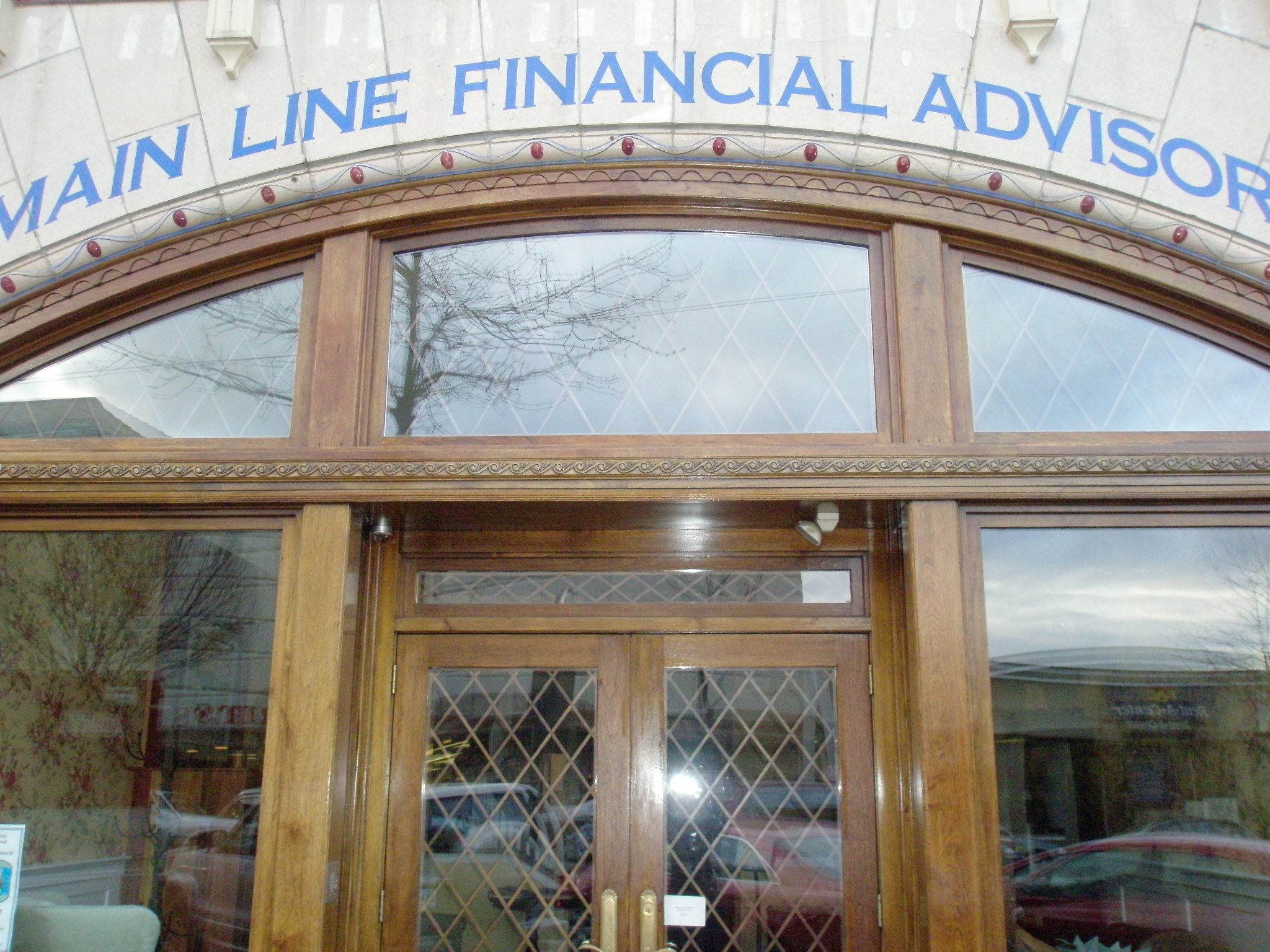
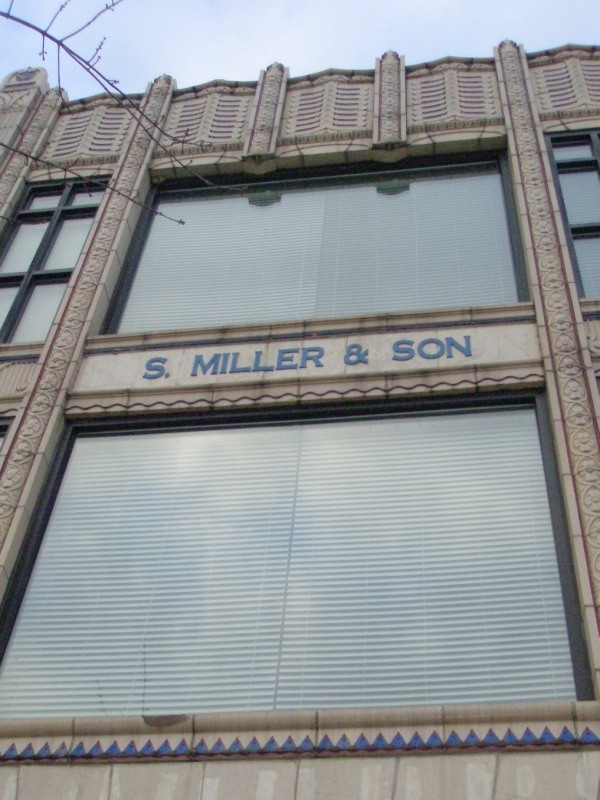
Main Line Financial Advisors occupy the former S. Miller & Son building at 211 East High Street. The image in the Positively!Pottstown header was taken from a photo of their front doorway. In addition to the intricate woodwork, I liked the blue of the letters and tried to mimic it in my header. Then I went for the Curlz MT font to mimic the woodwork. Totally amateur design sensibility!

S. Miller & Sons was a men’s clothing shop. The Millers were a German-Jewish family that came to Pottstown in the 1880s according to a story about a small Jewish cemetery on State Road in an Upper Pottsgrove newsletter from April 2009. (Unfortunately, the direct link to that newsletter seems to be broken now.)

There are just so many funky factoids out there in cyberspace. Check out this link from a publication called “The Clothier and Furnisher, A Monthly Journal Devoted to the Interests of Men’s Apparel,” established in 1872 and published out of New York City. On page 50 of their February 1895 issue, it says, “As soon as their alterations are completed, S. Miller and Son, clothiers, Pottstown, Pa., will occupy the store at 211 High Street.”

S. Miller & Son Facade

In another publication called The Railroad Trainman, Vol. 25 from 1908, S. Miller & Son is listed as being located at 221 High Street. Maybe that was a typo? Apparently, the Brotherhood of Railroad Trainmen allowed members to list businesses in their towns, encouraging other members to patronize them. Hmmm… my paternal grandfather spent his whole career working for the Reading Railroad out of Pottstown. Wonder if he was a member…

Main Line Financial Advisors does financial planning for individuals, families, businesses and institutions, along with integrated accounting and tax planning. The company was founded by Alfred “Fred” F. Matarazzo; his son Alfred “Al” F. Matarazzo, Jr. is the managing partner. In 2005 they expanded and developed their Pottstown office. They also have offices in Narberth and Malvern.

Main Line Financial Advisors
211 East High Street
Pottstown, Pennsylvania 19464
P: 610.323.5860
F: 610.323.5861

Cool architecture, financial planning, Jewish immigrants, trainmen and massage – you never know what you’re going to run into at Positively!Pottstown…

ANOTHER HINT!

ANOTHER HINT TO HELP THE DETECTIVES “SEE” IT: There’s a pattern on the windows above the woodwork. You have to look at the image on the blog. It’s not visible on the Facebook icon. If you’re walking in the 200-400 blocks of High Street, try to find the pattern on the windows and you will be led to the woodwork. (Hope the glass still looks like that…)

UPDATE: Inspiration – it’s in the details CONTEST!

There were a few comments on the Positively!Pottstown facebook page. So far we’ve got Positively Pasta and the Elks Lodge as guesses — but no winners.

Some great news: Barbara Kosiewicz of High Street Yoga has offered a 30-minute massage to the winner! Check out her blog here.

Okay, here’s a hint to narrow it down, so everyone can go out to High Street after work and solve this mystery: The building is in the 200-400 blocks of High Street.

SEE THE COMMENT BELOW FOR THE RUNNING LIST OF GUESSES!

Inspiration: it’s in the details

For a while now, I’ve wanted to talk about the image in the header of the Positively!Pottstown blog. I’ve thought about holding a contest to see if anyone can guess what building in town has the architectural detail shown in the photo. But, frankly, I worry that there might be a really long, cyberspace silence, and that’s not good for a blog’s business! Okay, what the heck? I’m a writer, I’ve endured plenty of rejections, let’s do it anyway!

Does anyone know where those little, carved wood curlicues live?

Hints:
They’re on High Street.
You do not need to trespass or climb a ladder or creep through alleyways to see them.
You do not need special glasses or binoculars, just an eye for detail.

I’m kinda hoping the people who own/use the building won’t give it away, although I’ll gladly post about the history of the building, its current use and some more photos once it’s identified.

I’ll scare up a gift certificate to somewhere for the first person who identifies the building. Let’s have a deadline of tomorrow at 3 pm.

Time to take a stroll!

Profile: Jason Bobst, Borough Manager

The view from Jason Bobst’s third floor office in Borough Hall provides a glimpse of the work he faces every day, managing what is essentially a small city that has a small-town feel.

As Pottstown’s Borough Manager, Bobst oversees not only the typical activities of local government, but three other entities that are more often associated with cities and usually governed by separate entities. These are the Pottstown Area Rapid Transit system, the Pottstown Municipal Airport and the Borough Authority, which provides water and sewer to residents and businesses. That’s a lot of responsibility for any manager, but 28-year-old Bobst takes it all in stride and is already making his own mark on the position.

“One of my biggest goals is to get citizens more active,” he said. And the key to that is communication. By using technology more effectively and holding face-to-face meetings in every ward, Bobst hopes people are encouraged to get involved.

The Borough now sends out a newsletter three times per year, and there is a monthly show on PCTV about various aspects of local government. On the odd-numbered months, the program features Bobst and an elected Councilor. On the even-numbered months, a department head is featured, talking about what exactly their department does.

Another use of technology is the implementation of the Swiftreach Network, or Swift911. Residents and businesses can sign up to receive calls in the event of an emergency or for getting important information. More about this service can be found on the Borough’s home page and, if you’re interested, you can then fill out this form.

These communication efforts are coupled with the recently-instituted ward meetings, which take place in the neighborhoods and give residents a chance to get to know and directly address their elected officials, police, a public works representative and Bobst.

Jason is a 2004 graduate of St. Joseph’s University, where he majored in business administration and political science. He stepped up to Borough Manager a little over a year ago, after starting out as Assistant Borough Manager in September 2007 and serving as interim Codes Manager and interim Finance Director before taking the helm.

In view of the recently proposed amendments to the rental ordinance and the Pottstown Partnership coming to fruition, he said, “There’s a concerted effort now to get things done, being pro-active rather than reactive. We need to keep setting goals and benchmarks and have a plan of attack. I may not always have the answers, but I know where to get the answers.”

Eventually, he’d like to get his master’s degree in public administration.

“It’ll happen, but I’ve been kind of busy since starting this job,” he said with a smile.

What does he listen to on his iPod to relax?

“I like the whole range of classic rock. Chicago, Led Zeppelin, K.C. & the Sunshine Band, Phish. I grew up listening to WOGL.”

Jason Bobst, Borough Manager

That’s 98.1 FM, an oldies radio station that plays a lot of songs that some of us – ahem – listened to when they first came out in the 1960s, ’70s and ’80s.

And Bobst admitted to being a Parrot Head, a commonly used term for a Jimmy Buffett fan. He hasn’t missed a concert since he was 15! So, we’ll let Jimmy wrap this up, tug on our heartstrings and carry us through the weekend. This is his 1974 hit, “Come Monday.”

Thanks, Jason!

Blog at WordPress.com.

Up ↑