Art Goes to School

If you pose the question “what is art?” to a room full of kindergarteners, you will get all kinds of answers. As usually happens with kids, the first answer kind of sets the trend for the rest.  So, if the first child says “art is when I play with play-doh,” you are bound to get at least four more answers pretty much like the first.  Then, you will get a few who want to tell you about their dog, or their sister, or even what they had for lunch

But if you keep calling on them, you might get the kind of answer that art teachers really love, just as I got last week in my first volunteer gig with Art Goes to School.  One round- faced five-year-old raised his hand and summed it all up in one sentence:  “Everything is art!”

Art Goes to School (AGTS) might just be the coolest program that you don’t know about. The local chapter of this non-profit volunteer organization brings art history and appreciation to kids in the Pottstown School District every winter, and has been doing so for the last 20 years or so. Another chapter visits the Owen J. Roberts elementary schools.  Started under the auspices of the Junior League in 1962, AGTS became an independent non-profit about 10 years ago and today has grown to include 52 groups in PA and NJ.

Basically, all AGTS volunteers work with the same portfolio, which changes from year to year. In the fall, chapters meet to discuss the works, this year ranging from the well known like Andy Warhol’s famous portrait of Marilyn Monroe to the obscure like The Poultry Market by Walter Henry Williams, and get familiar with all the works.  Then, each volunteer gets to bring their own particular style to their presentation, which, for me meant asking the kids what they think art really is.

Once we waded through some silly answers and I heard what about half the class got for Christmas, we got down to the business of looking at some art and talking about what they liked and didn’t like.  I, personally, loved having the little kids because there is something so unguarded about the way they approach art and they have no filter (for better or for worse) about sharing what they think. Because I have some idea of the average attention span of a kindergartner in the late afternoon of the first day back after winter break, I brought brand new crayons and asked them to draw something for me.

When they were done, we compared them to some of the prints I had picked to show the class.  They giggled over Picasso’s Portrait of a Woman and again at Frida Kahlo’s prominent eyebrows in The FrameBut, eventually, we had a really great discussion about how not everyone sees things or will draw them in exactly the same way, and each kid left the room clutching their drawing and, I hope, knowing a little more about art.

The Pottstown Chapter of AGTS also encompasses the high school kids, with four students each year participating in the volunteer program as part of their senior project.  These students have a chance to observe other volunteers when they present at Blessed Theresa of Calcutta (formerly St. Pete’s for any Pottstown expatriates).  Then, once they have done their practice presentation for other Art Students at the high school, they can start logging the hours they need for their project.

The Art Goes to School program in Pottstown runs through the middle of February and volunteers will be visiting classes in all grades, 4K to 5th, at all five elementary schools.  So, if you have a child in a Pottstown school, be sure to ask them what they thought of The Yellow Cow (by Franz Marc) or The Road Menders (by Van Gogh). Their answers just might surprise you.

Literary dreaming

Okay, I’m here amid the snow-covered Green Mountains, hanging with my writing buddies at the end of  a long day of readings and workshop, and I get to spinning out part of my dream scenario for Pottstown’s revitalization. This particular version includes a writing center in Pottstown, where my buddies and other writers – maybe they’ve published books, maybe not yet – can stay in a gorgeously renovated Victorian bed/breakfast writers’ retreat for 1-4 weeks, for a modest weekly fee. Writers are always on the lookout for a reasonably-priced retreat, where they can get some work done. (Maybe we’d entice them with a tour of The Hill School, where Tobias Wolff spent some time, or maybe a trip to Shillington, home of John Updike.) We might even be able to get some writers to visit a class in the schools, do a program at the library, or give a reading at night. Some of my people here like the sound of all this. And, you never know — if we built a solid network of authors who had already been to Pottstown, the next step might be to invite them all back, along with others, and begin hosting an annual literary arts festival. Wouldn’t that just turn the world’s perception of Pottstown on its head? Would make a really good story, too…

SCORE Scholarships

I’ve now added a tab at the top of the blog for folks to easily find the info and application for two SCORE scholarships – each valued at $100 – for the January Small Business Workshop Series. The scholarships are for anyone running a Pottstown-based business who would like to learn, or brush up on, solid skills needed to succeed.

I have also been contacted by a donor who has offered $100 toward another scholarship. Depending on how many applications we get, we may use it now or use it for the next workshop series in April/May. It would be great if we can get a couple different donors for each series and keep this going to support local business.

Take your pick: Variety of music on tap this weekend

There are multiple musical events happening in Pottstown this weekend. I’m going to let you know about all of them, and then you can decide what you’re in the mood for!

(1) At 3 p.m. on Saturday and Sunday afternoons, the Senior Theater Performance Troupe at the Tri-County Performing Arts Center will put on their Veterans Day Tribute. They will celebrate all veterans with a USO-style show filled with popular songs from the Civil War through World War II. Tickets are $12 for adults; just $10 for students and seniors; and $8 for children 12 and under. Go here for tickets and more info. Tri-PAC is located at 245 High Street, Pottstown, PA 19464.

(2) If you want to continue enjoying great music while honoring veterans AND support the Pottstown High School Boosters, you will want to get your tickets ASAP for the Veterans Day Extravaganza this Saturday, Nov. 13 at the Stanley I. Davenport Center for Performing Arts at Pottstown High School, 750 N. Washington Street. Doors open at 5:00 p.m. and the show starts at 6:00 p.m.

Organizer, music enthusiast and dedicated booster Tom Coyle has put together an amazing line-up of classic doo-wop and oldies performers, guaranteed to bring back fond memories. The list at press time includes: Jimmy Beaumont & the Skyliners (“Pennies from Heaven”), the Duprees (“You Belong to Me”), Shirley Alston Reeves & the Shirelles (“Soldier Boy”), and Larry Chance & The Earls (“Remember Then”). The show will be hosted by radio personality KING ARTHUR of SoundsofPhillyRadio.com and WNJC1360.

Tickets are $45 and will benefit the PHS Boosters. Keep the fun going at an after-concert DJ dance at the Elks Lodge, 61 High Street Pottstown, PA 19464 (Cover: $5.00). Contact Tom Coyle directly for tickets at 610-306-9361 (NOT the school.)

(3) And, finally, if you want to hear one of the most accomplished and magical choirs in the country, you should head over to Emmanuel Lutheran Church at 150 N. Hanover Street on Saturday evening, where the Westminster Choir from Princeton, NJ will be conducted by Joe Miller. Special guests include the Hilltones and Hilltrebles, a capella groups from the Hill School.

The Music at Emmanuel series is now in its 27th season and brings extraordinary musical talent to downtown Pottstown, usually for free. The Minister of Music at Emmanuel Lutheran is Andrew Meade, who received his master’s degree from Westminster. He has been at Emmanuel since September 2009.

“With a group of really well-trained singers led by an incredibly talented conductor, the energy and vibrancy of sound will be unlike anything most people will have heard before,” he said.

I couldn’t agree more. For a sample of the angelic sound of this choir, check out this performance of Peter Christian Lutkin’s choral benediction The Lord Bless You and Keep You. It was recorded this past May, just before graduation, in the Princeton University chapel.

The Emmanuel Lutheran sanctuary, beautiful and with great acoustics, seats 450 people. Tickets for Westminster Choir are $10 at the door. Students with a valid ID get in free. The concert this Saturday begins at 7:30 pm. A reception to meet the artists follows every concert.

Open Doors 2010: Pottstown Feels the Love

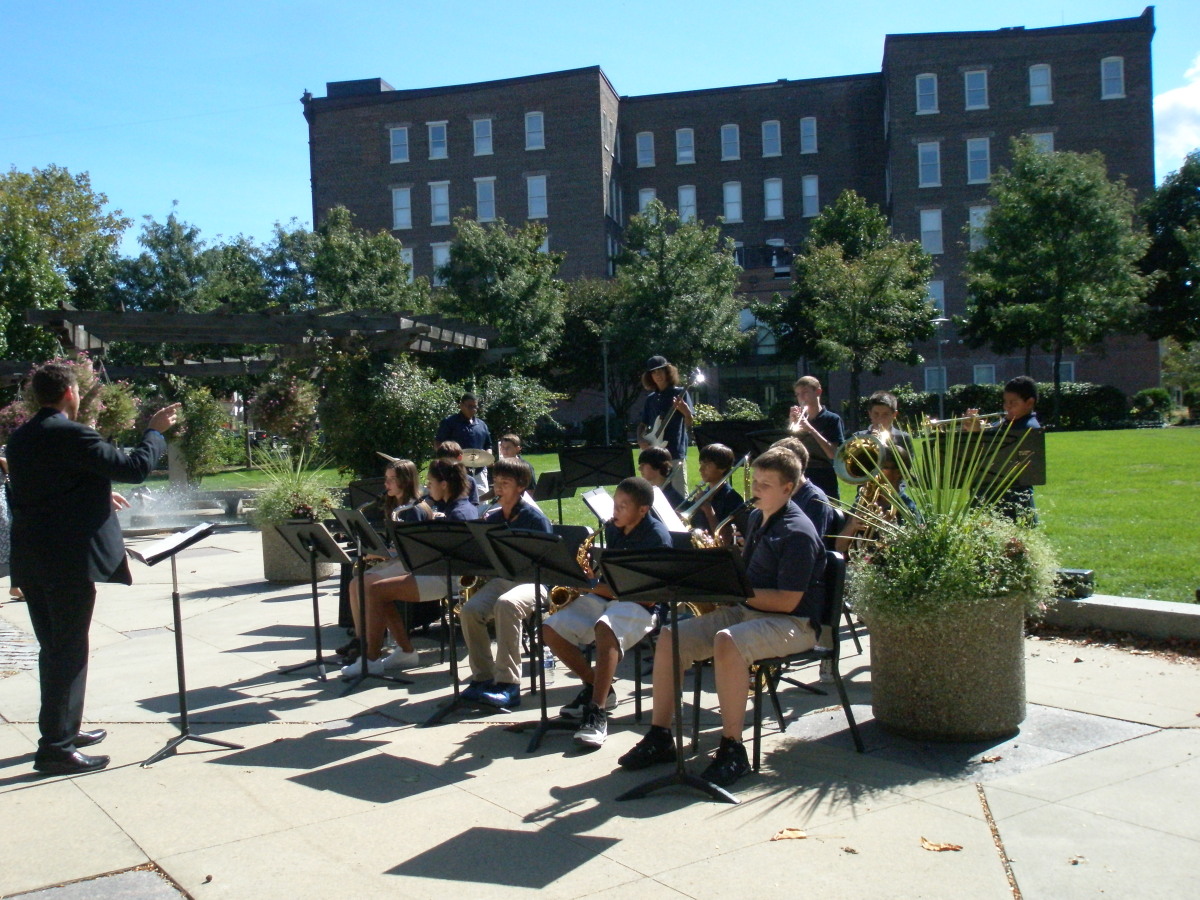
Jazzy tunes from the Middle School
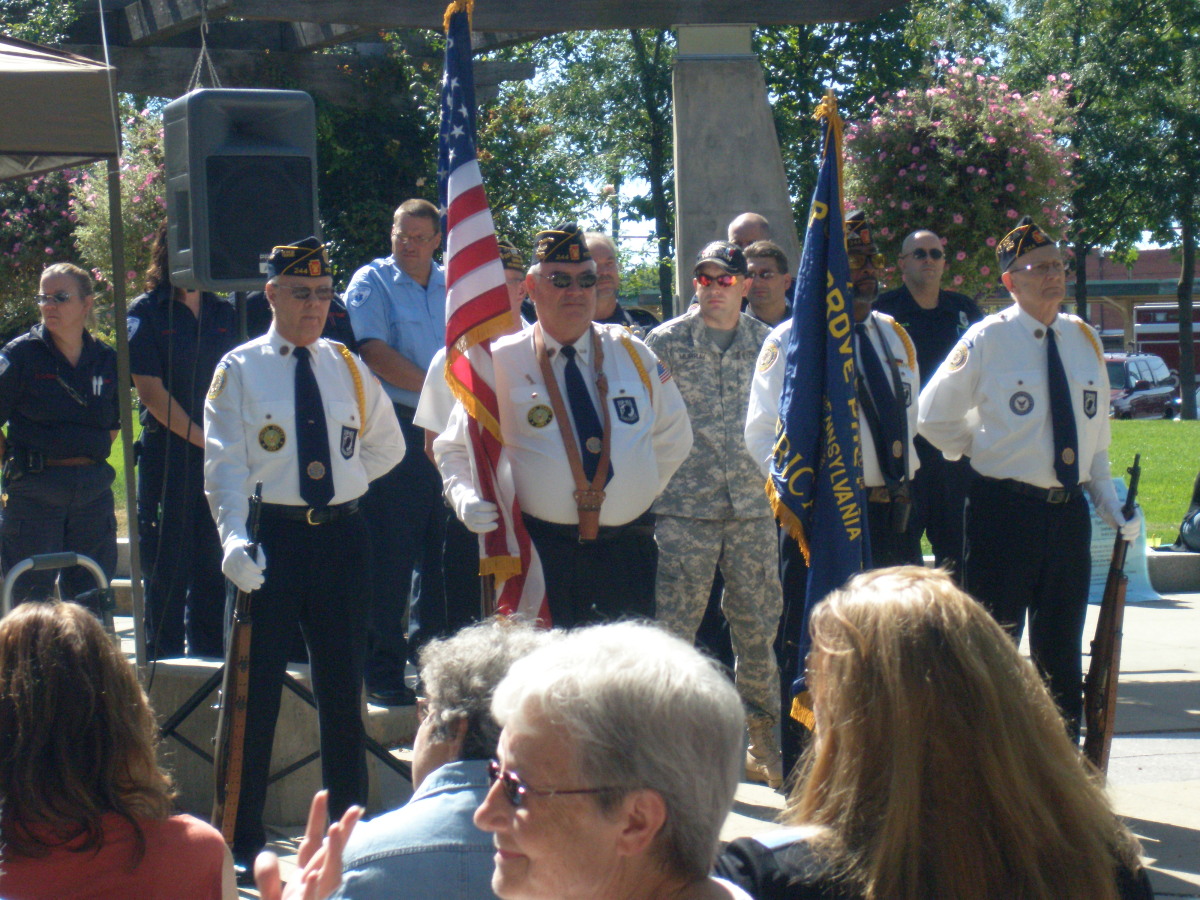
I was kind of holding my breath as the commemorative service got underway in Smith Plaza yesterday morning. I’m sure I wasn’t the only one, scanning the good-sized crowd, trying to gauge how many were there, and whether their numbers would swell or dwindle as the daylong community events, spearheaded by the Pottstown School District and the Pottstown Arts and Cultural Alliance, played out.

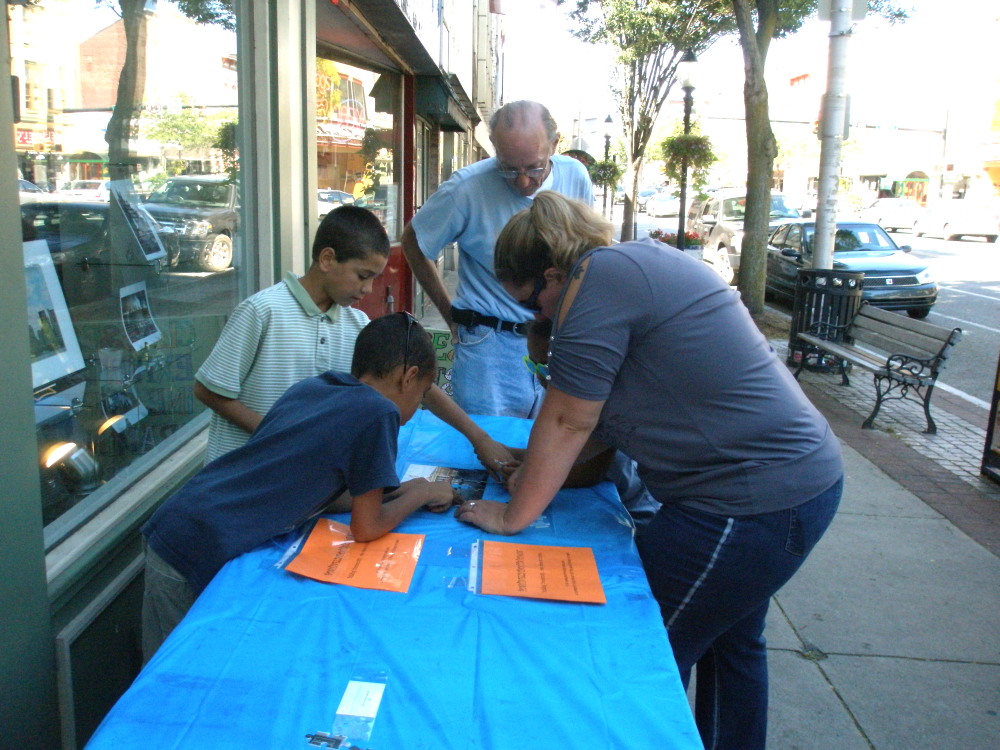
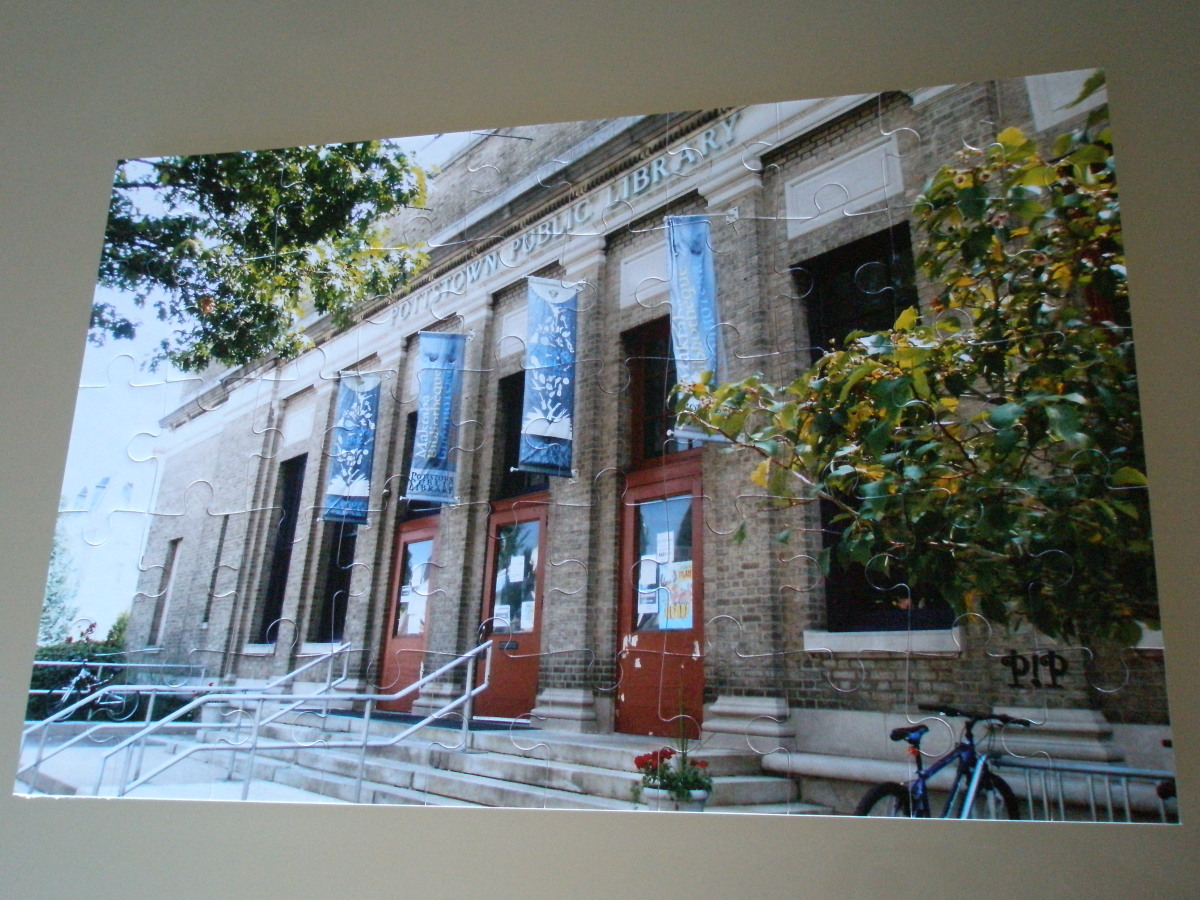
After heartfelt speeches, memories of that fateful day in 2001, the honoring of service and rescue personnel, and a moving poem by Ron Downie, I headed up High Street with fellow blogger, Mo Gallant, who writes Pottstown’s Blog. I’d already set up my puzzle- and community-building activity at the Pottstown Regional Public Library and we were going to finish setting up on the sidewalk in front of The Gallery School.

Honor & remembrance

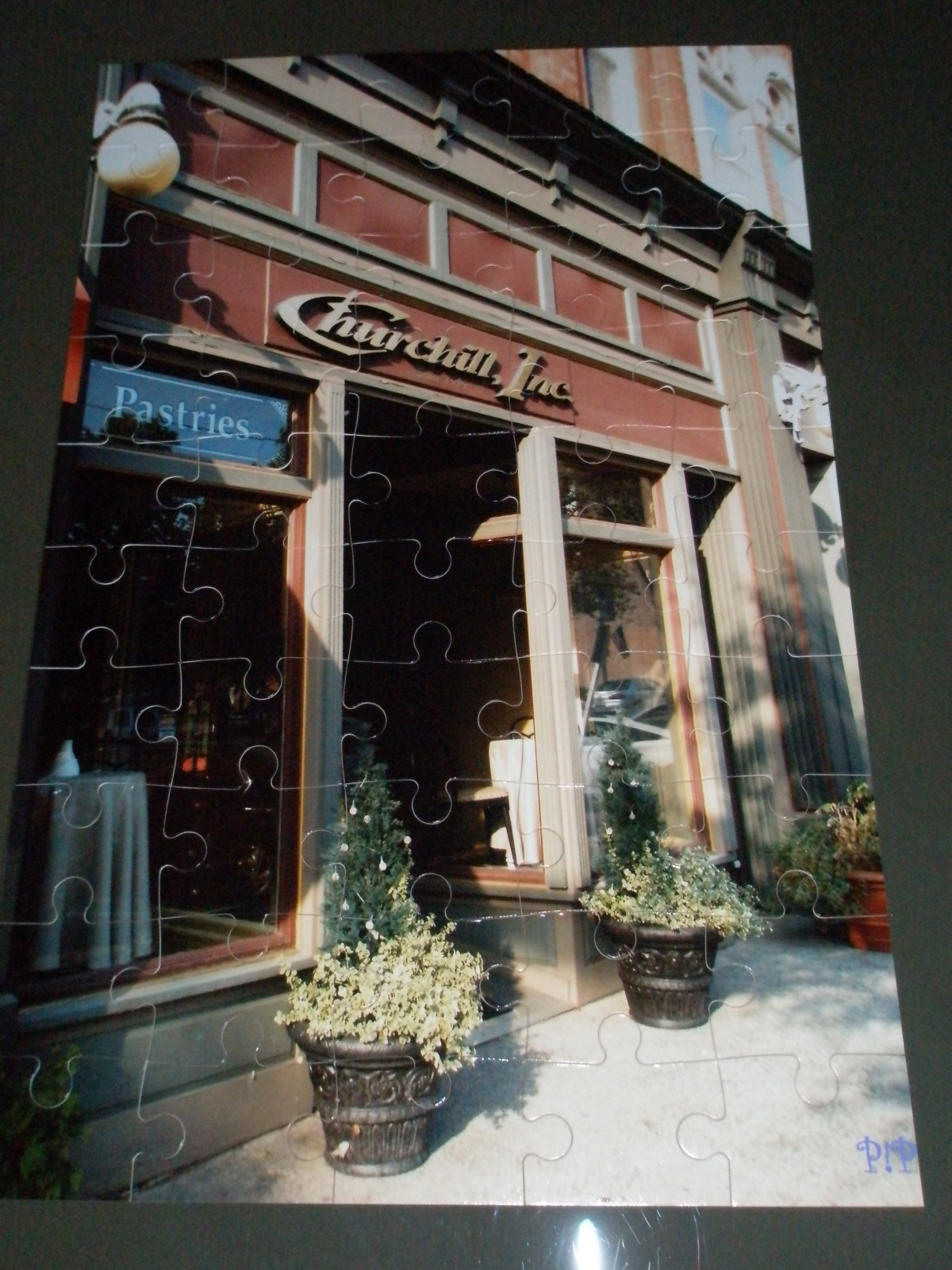
While School Board member Michele Pargeon coaxed passersby to check out the inside of The Gallery, a few determined puzzle-builders got busy with the first pass at puzzles of The Gallery, the Middle School, Borough Hall, Churchill’s and Smith Plaza. Bill Krause emerged from The Very Best next door and shot the breeze with us for a couple minutes. Council President Steve Toroney and his wife came by, so did Dave Kraybill, Executive Director of the Health and Wellness Foundation after picking up a free bike at Tri-County Bicycles through the Bike Pottstown program. Periodically, Mo and I would look up and down High Street and say, “They’re here. People are really here.”

That feeling of wonder only grew in strength as the day unfolded.

After putting some stuff in my car, which was parked for free all day in front of the Tri-County Performing Arts Center, Mo and I popped in for a quick hello to Executive Director Marta Kiesling. Then, at an outdoor table at Juan Carlos Fine Mexican Cuisine, we indulged in the sublime Mexican egg rolls with honey jalapeno dip and their spicy Mexican Caesar salad.

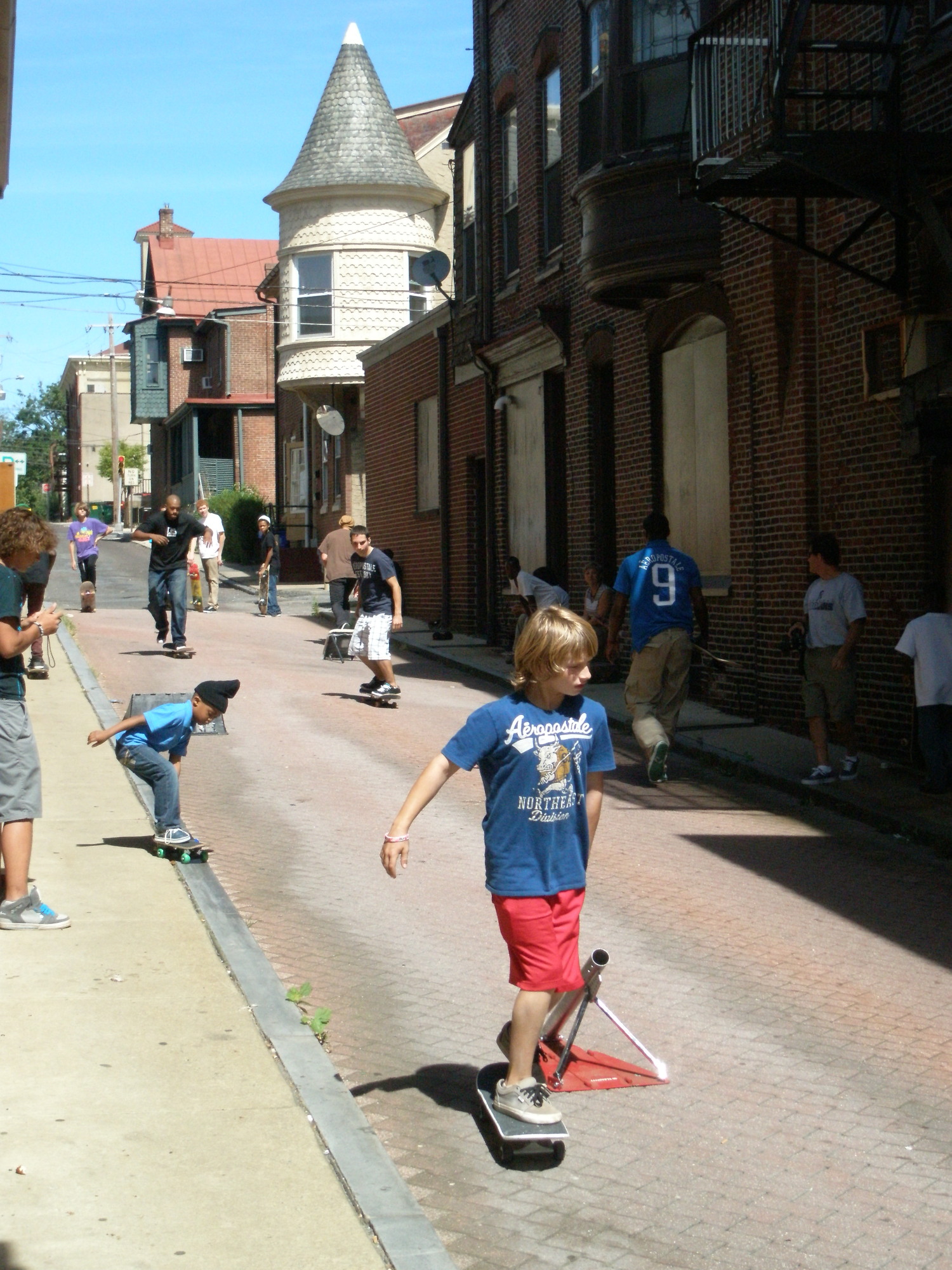
Penn Street skateboarders
Skateboarders from Bentley’s Boards Skate Shop kept us entertained on Penn Street. Mayor Bonnie Heath, her husband Mason Craig, Borough Manager Jason Bobst and Main Street Manager Leighton Wildrick were at a nearby table, and that outdoor spot was perfect for people-watching, saying “hi” and meeting new folks. As lunch was winding down, I realized that I was in the midst of a perfectly balanced, lively urban/small hometown experience. Great food, people of all ages on the street, full trolleys passing by, and outdoor dining in a place where “everybody knows your name.”

As it got closer to three o’clock, Mo and I bid farewell (Thanks, Mo! Thanks, Michele, for looking out for the puzzles!) Then I headed to the Library to make a quick stop and see how things had gone over there. On my way up High Street, I slowed down to take in the crowd and the thumping salsa beat in front of SwingKat and Grumpy’s Handcarved Sandwiches. Music! Joy! Dancing in the streets! This was Pottstown on September 11, 2010. Mark it on your calendar. Imprint it on your souls.

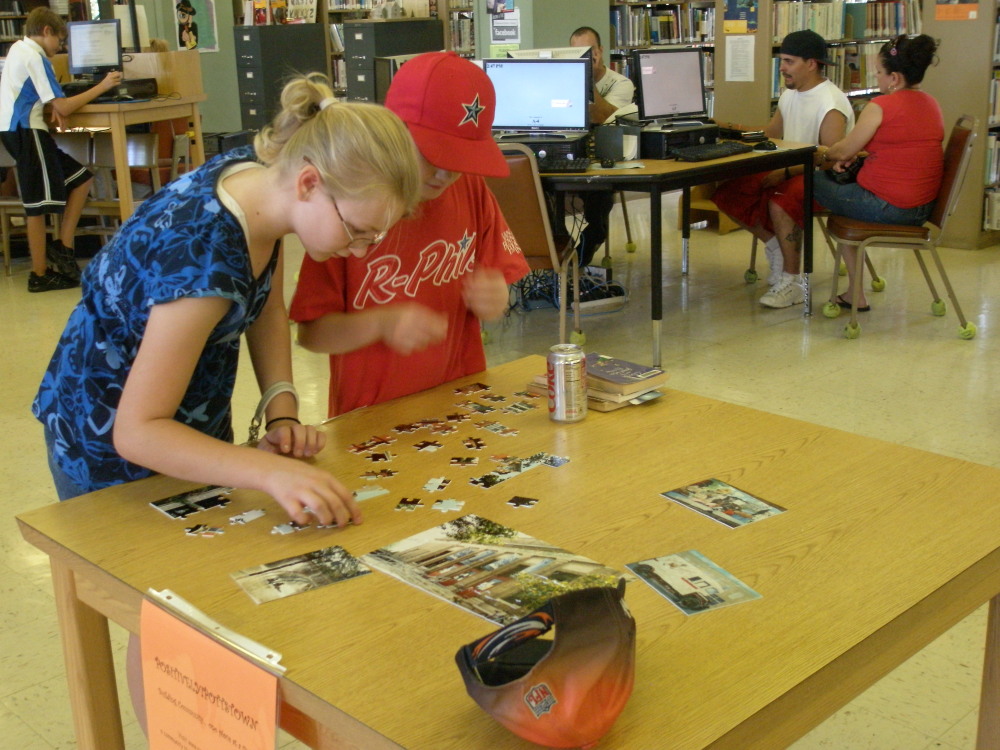
The puzzle report from Mike Packard at the Pottstown Regional Public Library was thumbs-up. If you haven’t been to the library recently, it’s got a whole new look inside, with the fiction downstairs and popular and current fiction on display. Check out the way-cool teen room downstairs. And there was popcorn! In the library! The smell was heavenly. If they keep this up, they’re going to give the big bookstores a run for their money.

Library puzzlers

I made my way to the high school where school district volunteers and staff had lined the cafeteria and halls with tables for any community and school group that wanted to participate. I set up my puzzles and free book raffle in the cafeteria and never got a chance to see the hallways filled with people, including elected officials from both Borough Council and the School Board. In addition to all the families and young puzzle fanatics who stopped by, there was Erica Weekley of the Borough’s economic development staff, and Tim Phelps of Tri-County Area Chamber of Commerce and his family.

John Armato, Director of Community Relations for the Pottstown School District and Superintendent Dr. Reed Lindley both stopped by to chat and thank me for being there. It wasn’t just me – they were talking to everyone. It’s obvious that these leaders are real people-persons and that they are “for real.”

In closing, I’d like to hearken back to my blog post of August 8 – The work of the community. From a community revitalization perspective, yesterday was a HUGE bump up to the next level. The community sees the positive and good things it’s capable of. You never know when that’s going to happen – that breakthrough – but once it has, in a lot of ways there’s no turning back.

While yesterday provided the community with a long moment of harmony, where the results of true teamwork were visible and palpable, every day isn’t going to be like this. But the more of these moments that you can string together, the better prepared you will be to get over the rough spots in between, together, with ultimate faith and trust in each other. Congratulations, Pottstown – you’re awesome!

Open Doors = Open Eyes + Open Minds + Open Hearts

This Saturday, September 11th, Pottstown will commemorate the tragic events of that day, nine years ago.

After opening ceremonies and remembrances at Smith Family Plaza at 11 am, the School District, businesses, arts and community groups, The Hill School, Genesis Housing, Pottsgrove Manor and more are publicly opening their doors for the rest of the day to encourage people to spend time together, get further acquainted with their downtown, and to strengthen community bonds. The School District initiated the event, which has come to be known as “Open Doors.” It’s got a contagious, positive vibe that’s almost magical, judging from today’s Mercury.

Churchill Cafe puzzle
The Mercury is running articles all week. For news stories and a schedule, check out the District’s website here, and the Pottstown Arts & Cultural Alliance blog here.

In general, downtown locations will have special events going on from 11-3.

From 3-6 pm, the High School will hold an open house – with a gazillion activities! – followed by a home football game at 7 pm vs. Upper Moreland.

Building community, one piece at a time…
From 11-2:30, Positively!Pottstown is offering puzzle-building at tables at The Gallery on High and the Pottstown Regional Public Library. Puzzles of various Pottstown buildings will be available for anyone to piece together at these locations. They can then be broken up and started all over again. Fun for adults and kids!

At 3 pm, the puzzle-building will continue over at the High School. There, students can also put their name into a free drawing for a book; there will be books for all grade levels. Buildings… books… what else do you expect from a planner and writer? 🙂

Building community... one piece at a time

Big shout-outs!
Much thanks to Mr. Armato at the High School, Mike Packard at the Library, and Erika Hornburg-Cooper of The Gallery School for providing space for the puzzles.

Summer Performing Arts Camp at Tri-PAC

By now many readers of this blog have experienced – I hope! – at least one performance at the Tri-County Performing Arts Center at 245 E. High Street in downtown Pottstown. If not, don’t worry – they just keep comin’. Having just put on a widely-acclaimed production of Ragtime, The Musical, they recently announced their Summer Concert Series, which will feature the Jen Chapin Trio on July 16, the Travis Wetzel Trio on July 30 and Maggie and Mark Moliterno and Friends on August 20.

Also on tap is Tri-PAC’s 7th annual Performing Arts Summer Camp for children. There are 3 sessions to choose from, beginning on July 5th, July 18th and August 2nd. Each session lasts two weeks. There are some spaces still available, so email or call today! (Contact rebecca@villageproductions.org or call 610.970.1199)

The summer camp offers students entering grades 1-12 a chance to explore drama, voice and dance with professional instructors. A new format for middle and high school students allows beginners and more experienced performers to try out one of these areas of concentration or advance their skills, whatever suits their interests or needs.

Students in grades 1-4 will take part in an interdisciplinary curriculum, giving them broad exposure to improvisation, theater movement, vocal expression, writing/drawing and making instruments. They can attend for half- or full-day with short breaks in the morning and afternoon, along with lunch (which is “bring your own.”)

For students in grades 5-12, it’s a full-day program from 9am-4pm. This year Tri-PAC has added concentrations in acting, voice, and dance, so that these older kids can work intensively in one of these areas. A student can still be a beginner and sign up for one of the concentrations and really immerse themselves in it. Half the day is spent in their area of concentration and the other half is spent working to put together an ensemble performance, which will be presented on the last day of each two-week session.

For students in 11th and 12th grades (and recent high school graduates) there is also a Counselor-In-Training program.

Tri-PAC’s summer camp options continue to evolve to encourage participation in the performing arts by newcomers and experienced students alike. If you’ve got a budding performer in your family, check it out! There is a Student Referral Incentive program and need-based financial aid available. Full information and registration forms are available at http://www.tripac.org.

First Suburbs: Affordable Housing Notes from NJ

Affordable housing policy is near the top of any First Suburbs agenda and rightly so. In towns that are experiencing the economic disinvestment described earlier – the loss of industry and large and small businesses – the value of the housing stock becomes more critical to the property tax base. And because education is by far the most expensive part of public services, a strong housing market is essential. Yet, the housing markets in First Suburbs suffer the same kind of disinvestment. How can the cycle be broken? Of course, that’s the multi-billion dollar question. And, of course, there’s no way I can answer it. All I can offer here is a resource for your further investigation of the regional and statewide inclusionary zoning system that has evolved over the past 35 years in New Jersey. I hope that these notes and links can inform the conversation and spark some ideas that help SEPA’s First Suburbs as they advocate for more equitable housing policies in their own region.

The New Jersey Fair Housing Act was passed in 1985 to try to even out social, economic and educational disparities between cities and suburbs. The Legislature passed it in response to a couple of New Jersey Supreme Court rulings, Mt. Laurel I (1975) and Mt. Laurel II (1983). The first decision basically found that large-lot zoning laws didn’t allow for a variety of housing types at varied price levels, which excluded people of color and of lower incomes. The second decision created the foundation for a system for determining a “regional housing need,” the “fair share obligation” of individual municipalities in that region, and the “builder’s remedy,” described below.

The Fair Housing Act created a Council on Affordable Housing and a vast body of regulations and calculations to assign a “fair share” number of low- and moderate-income units to each town based on a variety of factors. The program was voluntary. Towns could submit Housing Plans, get them certified through a lengthy process, and then be monitored for compliance. The “carrot” part of this approach was that if towns did this, they couldn’t be sued by builders or housing advocates over their zoning. But if they didn’t participate in the system, they could be subject to “the builder’s remedy” whereby a builder/developer could sue the town to increase the zoning density so that he could provide affordable units in a new development – usually 20%, which would remain affordable (price-restricted) for 30 years. Special housing courts with judges and court masters – urban planners who specialized in affordable housing – would hear these cases and make decisions, essentially taking zoning control away from the non-participating towns. That was the “stick.”

When the Legislature stepped up to pass the Fair Housing Act (and stop the Supreme Court from interfering with local zoning), it created a mechanism – Regional Contribution Agreements (RCAs) – to water down the court’s influence by allowing towns to buy their way out of up to 50% of their affordable housing obligation. “Sending” towns could pass bond ordinances and send the money – based on an agreed-upon per unit fee – to a designated “receiver” city in their region. In this way, some towns reduced the number of affordable units built within their borders, but they also provided urban areas with much-needed rehabilitation and new construction funding at a time when the federal government was cutting these programs. Still, it was clearly a way around the original intent of the court decisions.

More than 25 years later, in July 2008, the NJ Legislature and Gov. Jon Corzine abolished the RCA provision and also created a non-residential development fee of 2.5 percent to be charged on non-residential construction or improvements to raise revenue for the construction and rehabilitation of affordable and workforce housing in the state.

New Jersey’s system grew out of strong, grassroots advocacy for lower income people in the state’s cities, who knew that inner-city residents were being systemically kept out of better public schools, and safe and clean environments due to exclusionary housing laws. Builders were also pushing against these laws for their own gain during a period of generally remarkable economic growth in a state with ever-diminishing developable land.

We are in a very different economic and political environment now. One of Gov. Chris Christie’s first moves was to order a 90-day moratorium on most of the activities of the Council on Affordable Housing. The NJ courts once again stepped in and issued a stay on a portion of the order, while it is on appeal. The Governor is now reviewing the results of a Task Force on the matter. Even though many suburban towns truly voluntarily participated in this system, changed their zoning, and opened up their communities and schools to low- and moderate-income residents who might not otherwise have been able to live there, the complexity and the burdens of this system are legendary here. It has certainly produced affordable housing (see numbers here) and some degree of economic and educational opportunity for thousands. But there are still very real differences separating our cities and more affluent suburbs, namely, blatant racial segregation. Still, I think those Supreme Court justices back in the ‘70s and ‘80s were on the right track, recognizing that ordinances and public policy can have discriminatory effects and staying on the alert to try to counteract any systemic inequities.

New Jersey’s property tax/school funding system is broken – to say nothing of “home-rule,” our 566 municipalities and 605 school districts! The current widespread fiscal crisis only puts that in high relief. Finding political, social and economic solutions, that are also pragmatic, remains our challenge – and probably will be for some time to come. Taking New Jersey’s experience into consideration, though, may help SEPA’s First Suburbs get a better feel for how some housing policies might play out at the intersection of the private and public sectors in their own hometowns.

Note: The original post said that Gov. Christie’s recent order was repealed; a stay was issued on a portion of the order while it is under appeal.

Sue Repko is a writer, licensed urban planner in New Jersey and a member of the American Institute of Certified Planners. She grew up in Pottstown and blogs at Positively!Pottstown.

Community Gardens & First Suburbs – the start of a (long) conversation

This is the first in a series about First Suburbs of Southeastern PA.

This past Saturday a community gardening project took place at a corner park in the heart of Pottstown’s historically African-American neighborhood. The Washington Street corridor has faced its share of challenges over the years – challenges that many would characterize simply as “urban.” But by all accounts the gardening project was a huge success, bringing together a diverse array of children and adults, members of the broader community, and the energy of two organizations – Citizens for Pottstown’s Revitalization and Preservation Pottstown.

At The Mercury, this was news, before and after the event. Two local blogs, Code Blue and Save Pottstown!, promoted it ahead of time. And I certainly was thrilled to blog about it after the fact, thanks to the quick emailing of photos and updates from those in attendance.

To me, the fact that there was such a buzz is interesting in and of itself. What did this activity spark in individuals and the community? Can we try to define it, and in the process, become conscious of it, and try to do it again? There are all kinds of metaphors that spring forth from the gardening/growing process that are apt here. But I also think the actual process of growing food and flowers is good and vital… and not for just one neighborhood. Rather, it’s something for all of Pottstown and the school district to consider as a powerful tool for revitalization, which brings me to the First Suburbs Project.

According to their website, “The Southeastern Pennsylvania (SEPA) First Suburbs Project is a coalition of community organizations and institutions focused on solving common challenges facing the older, developed suburbs of Bucks, Chester, Delaware, and Montgomery Counties. These communities share conditions of diminishing economic investment, declining infrastructure, struggling school districts, and social services lagging behind the needs of their residents.” Older suburbs and towns, like Pottstown, now find themselves face-to-face with a host of public challenges that were once thought to be the province of larger cities.

These conditions are the result of a self-fulfilling syndrome that works something like this:

Over a long period of time, disinvestment occurs due to range of causes, usually a combination of public policy and “free market” forces. Businesses and homeowners with rising incomes leave for literally greener pastures, creating sprawl. The people and businesses that remain must pay more in taxes to maintain the infrastructure, level of municipal services and school system. But these tax increases are too much for some more people and businesses; they leave. Over time, in an attempt to rein in taxes, services are cut. Property values do not go up under these circumstances, making properties concentrated in these areas attractive to investors, and decreasing the percentage of homeowners in a community. This downward spiral picks up momentum, and the chances for an economic recovery diminish even further

The (SEPA) First Suburbs Project advocates “state policy changes and regional solutions” as the best way to tackle these common challenges.

There will be a regional public meeting of the First Suburbs Project this Thursday, June 10 from 7-8:30 pm at South Hall on the Western Campus of Montgomery County Community College in Pottstown. SEPA First Suburbs coalition members want to hear the concerns, ideas, and questions of area residents, organizations, businesses and government officials about their very real experiences in the kind of environment described above.

I’m a firm believer in the potential for regional planning and public policy to mitigate these problems, and I encourage everyone to get to this meeting, speak out, listen and learn more about the possibilities for changing some of the inequities in public policy at the regional, state and even federal levels.

That’s on the one hand.

On the other hand, Pottstown cannot afford to wait for larger, slow-moving, governmental/political behemoths to change their own deeply-entrenched fiscal and social policies. Pottstown must continue to try to define a new course for itself ASAP… while simultaneously pursuing broader changes with other communities that find themselves in the same boat.

And this is where I come back to community gardens.

Below is my quick list of what might have made that such a great experience for those who were involved, and why it brings a smile and hope to someone reading about it. Readers should feel free to add to the list.

What’s Great about Gardening

    – Getting hands dirty; being a kid (again)
    – Adding beauty to surroundings
    – Transformation before your very eyes
    – Having responsibility to care for something that’s your own
    – Being given the chance to nurture
    – Anticipating wholesome food
    – Being around cheerful adults
    – Being pro-active; feeling of taking control, being in charge
    – Sharing snacks/food with other human beings after a job well done
    – Feeling that you are part of a caring community, not alone

    As I’ve blogged before: Community gardens are growing in popularity, especially in places where wholesome foods, such as fresh fruits and vegetables, are not available or are too expensive. Basically, an available lot is divided up among interested residents and/or groups/clubs. Someone who knows something about gardening coordinates and teaches, so that participants end up with a steady flow of food and flowers. Of course, donations of tools, plants, seeds, soil are sought to make it all happen. Community gardens get people outside, get neighbors working together, provide better food at a lower price, raise awareness about nutrition and food production, and put an empty or nuisance lot to good use.

    During World Wars I and II, Victory Gardens in private yards and public parks were considered one’s patriotic duty to ease pressure on the food supply.

    So, what does this have to do with Pottstown’s revitalization on a larger scale?

    Private gardens were very much a part of my growing up. Just about everyone grew tomatoes. Picking apples and making applesauce were, and still are, an early fall tradition for my mom. These were traditions enjoyed by many immigrant, hard-working families that came to Pottstown to work, raise a family and improve their standard of living. Small-scale gardening is part of Pottstown’s past, and in these fiscally-challenging times, it makes a whole lot of economic sense to think about how to bring it back… but with a modern take.

    What if Pottstown became known as a place with a strong private and community gardening movement in its neighborhoods and the schools?

    As a non-resident, I don’t know the extent to which any of the items on the brainstorming list below are possible or already in the works. My inclination is to always just put ideas out there to see if any of them resonate on the ground, where people live.

    Ideas for Extending the Washington/Chestnut Park Project

– Identify a few Borough- or District-owned lots throughout town that might be suitable
– Factor garden space into the District’s land/building planning process, right up there with other energy-saving/sustainability measures
– Seek out several individuals with expertise and enthusiasm to guide smaller, working groups & organizations around town and in the schools.
– Get Bud Heller, Director of Food Services for the School District, on the case. Heller is a tireless advocate who has testified before Congress on behalf of the Fresh Food Produce Association and the School Nutrition Organization.
– Incorporate student-grown produce into menus?
– Is the healthy food program at Edgewood still going strong? Expand to other schools?
– Incorporate organic, small-scale food-growing concepts into science curricula
– Highlight the natural world in fiction, poetry and non-fiction in the English curricula
– Have science & English classes periodically come together for joint projects
– Is there a sustainability club in the high school?
– Have there been quantifiable efforts to reduce waste – in the cafeteria, paper, lights in classrooms, etc.– that engage the kids? See The Green Cup Challenge, which the Hill School has participated in. Tap The Hill, Montgomery County Community College and the Pottstown Garden Club for advice. So many people and resources right in Pottstown!
– Gardening does not have to be expensive; built-in labor pool in schools. Knowledgeable and generous landscapers and suppliers are out there, such as Eric Schmidt of Colonial Gardens, who provided materials for Pottstown’s gardening project.
– The Pottstown Health & Wellness Foundation’s grant program and Mission Good Nutrition videos are additional, key local resources.

The community gardening concept could be a way for Pottstown – and other First Suburbs – to take a past practice that was sensible and sustainable and re-claim it in a way that will appeal to anyone who wants to live in an engaged, progressive-minded community today. The power of people working together on an activity so basic to human survival should not be underestimated. Last weekend’s project at Washington & Chestnut Streets has given a glimpse of the positive, communal energy in Pottstown that is looking for a meaningful outlet. In a time when so much in the world seems out of our control, gardening can put some kind of power back into the hands of the people.

Note: The Pottstown Health & Wellness Foundation’s grant program and Mission Good Nutrition videos are additional, key local resources, which were inadvertently omitted from the original post.

Sue Repko is a writer, licensed urban planner in New Jersey and a member of the American Institute of Certified Planners. She grew up in Pottstown and blogs at Positively!Pottstown.
The winner is…

TERRI B. from Sanatoga! Congratulations!

Terri has received 2 free tickets to opening night of RAGTIME, The Musical at the Tri-County Performing Arts Center on High Street. RAGTIME will run from June 3-20. Thank you to Tri-PAC and Village Productions for donating the tickets!

Blog at WordPress.com.

Up ↑